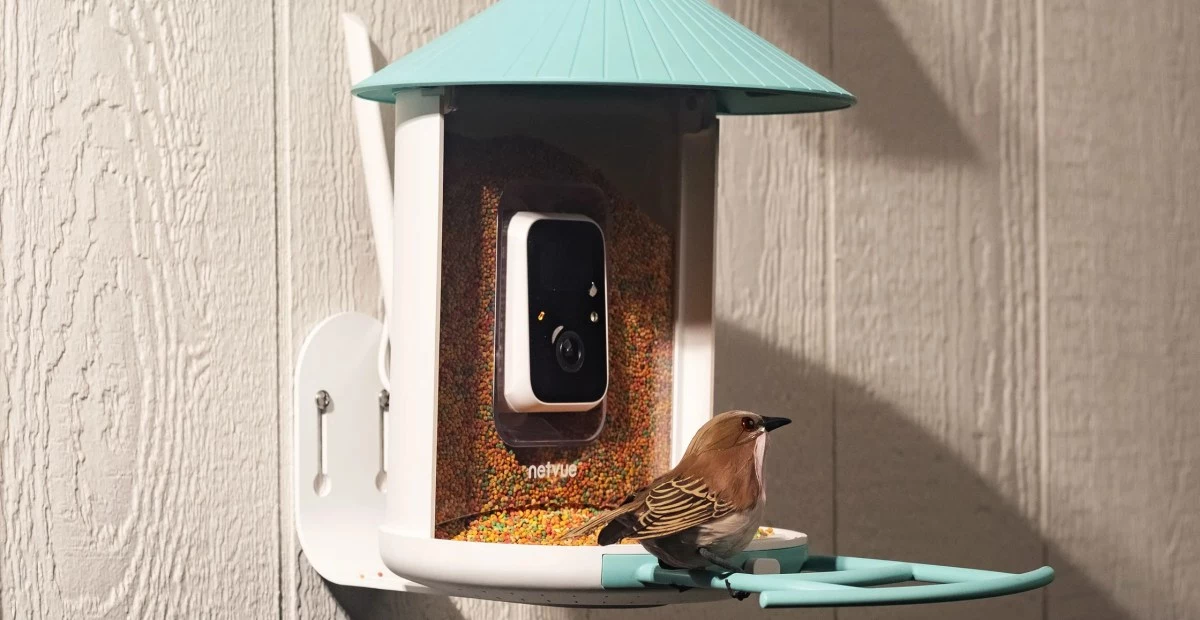

A midyear price shock that reframes the smart bird feeder category
Netvue’s decision to discount its Birdfy AI-Powered Smart Bird Feeder with Camera from $259.99 to $149.99—a $110 reduction and roughly 40% off—is more than a seasonal promotion. It is a clear signal that the “tech-enabled nature” segment is maturing into a competitive consumer IoT arena where pricing, platform strategy, and retention mechanics matter as much as novelty.
At the product level, Birdfy is positioned as a premium-feeling device at a newly mass-market price point, combining features that consumers increasingly expect from modern smart-home hardware:
- Solar-enhanced power management to reduce manual recharging and improve uptime
- 1080p wide-angle video with color night vision, aligning with mainstream camera expectations
- The Birdfy mobile app for real-time motion alerts, live viewing, and short clips
- On-device AI identification for 6,000+ bird species, plus common visitors like squirrels—without subscription fees
- IP65 weatherproofing and a 1.5-liter seed reservoir for practical outdoor deployment
- Storage flexibility via microSD and three months of complimentary cloud storage
The headline discount is likely to drive volume, but the deeper story is how Netvue is using pricing to accelerate adoption at a moment when consumer IoT buyers are more skeptical, more cost-sensitive, and more fatigued by recurring fees than they were even two years ago.
Edge AI without subscription friction: a strategic bet on “utility-first” hardware
Birdfy’s most consequential design choice is not the camera—it is the on-device AI. In a market where many smart devices gate core intelligence behind monthly plans, Netvue is leaning into a model that can be described as “AI once, perpetual utility.” That matters for two reasons.
First, it lowers the psychological barrier to purchase. Consumers have learned to ask a blunt question at checkout: *What stops working if I don’t subscribe?* By keeping species recognition on-device, Netvue reduces the sense of hostage-taking that has crept into parts of the smart-home ecosystem.
Second, it reflects a broader shift in the economics of AI at the edge. As inference becomes cheaper and models become more efficient, vendors can increasingly ship meaningful intelligence locally—reserving the cloud for storage, sharing, and advanced analytics rather than basic functionality. This has implications beyond bird feeders:
- Consumer electronics OEMs may feel pressure to justify cloud dependence when edge inference is “good enough.”
- Smart-home competitors that rely heavily on subscriptions could face churn if buyers gravitate toward devices that remain valuable without ongoing payments.
- Privacy and latency narratives improve when identification happens on-device, even if video storage still touches the cloud.
At the same time, Netvue’s inclusion of three months of cloud storage is a classic “try-before-you-buy” bridge to recurring revenue. The company is effectively separating core value (identification) from convenience value (cloud history, access, sharing)—a dual-track monetization approach that has become a best practice in IoT, especially as hardware margins tighten.
Solar power and always-on outdoor sensing: sustainability meets reliability
The solar component is not merely a green add-on; it is a reliability feature that aligns with actual usage patterns. Summer is when outdoor engagement peaks, and it is also when solar harvesting is strongest—meaning the product is most autonomous precisely when it is most likely to be used and shown to others.
This design choice sits at the intersection of two durable trends:
- Sustainability as product performance, not just branding: solar extends uptime, reduces maintenance, and improves the “set-and-forget” promise.
- Always-on sensing moving outdoors: as households expand their smart-home footprint beyond the front door, devices that can survive weather and operate continuously become more valuable.
Birdfy’s IP65 rating and reservoir capacity reinforce that it is built for real-world deployment, not occasional novelty. And the combination of motion detection, night vision, and wide-angle video mirrors the architecture of compact security cameras—hinting at category convergence. Wildlife monitoring devices may increasingly be evaluated not only as lifestyle gadgets, but as multi-purpose outdoor camera nodes.
That convergence raises strategic questions for the industry: will future products explicitly blend nature observation with perimeter awareness, or will brands keep those narratives separate to avoid privacy concerns and regulatory scrutiny? The technology stack is already overlapping; the market positioning is what remains fluid.
What the discount reveals about competition, inventory, and the next platform play
A markdown of this magnitude can indicate multiple realities at once: inventory management, customer acquisition, and preemptive competition. The smart-home market is crowded, and camera-equipped devices are increasingly commoditized. Aggressive promotions are often the fastest way to expand an installed base—especially when the long-term value is captured through app engagement and optional services.
Several market dynamics are likely shaping Netvue’s timing:
- Seasonality and demand capture: a midyear sale aligns with peak outdoor living and gifting cycles tied to summer activities.
- Post-pandemic nature engagement: interest in home-based wellness and nature experiences remains elevated, sustaining demand for hybrid tech-nature products.
- Margin pressure across consumer IoT: discounting can be a rational response to component cost shifts, competitive pricing, or the need to accelerate turnover.
For stakeholders, the implications are tangible. Retailers and e-commerce platforms will see these promotions as traffic engines, while competitors will be forced to respond either with price cuts or differentiated features—particularly around AI, storage, and power autonomy.
The more intriguing long-range opportunity sits outside retail: biodiversity and citizen science. Camera-enabled feeders can generate structured observations at scale, and with the right permissions, APIs, and governance, that data could support research partnerships or conservation initiatives. Done responsibly, it offers a path to brand credibility and differentiated value that pure smart-home devices struggle to achieve.
Netvue’s sale may look like a straightforward bargain to consumers, but strategically it reads as a bid to define the category’s next phase: edge-AI outdoor devices that are useful without subscriptions, sustainable enough to stay on, and extensible enough to become platforms rather than products.

 By
By
 By
By

 By
By
 By
By
 By
By
 By
By
 By
By