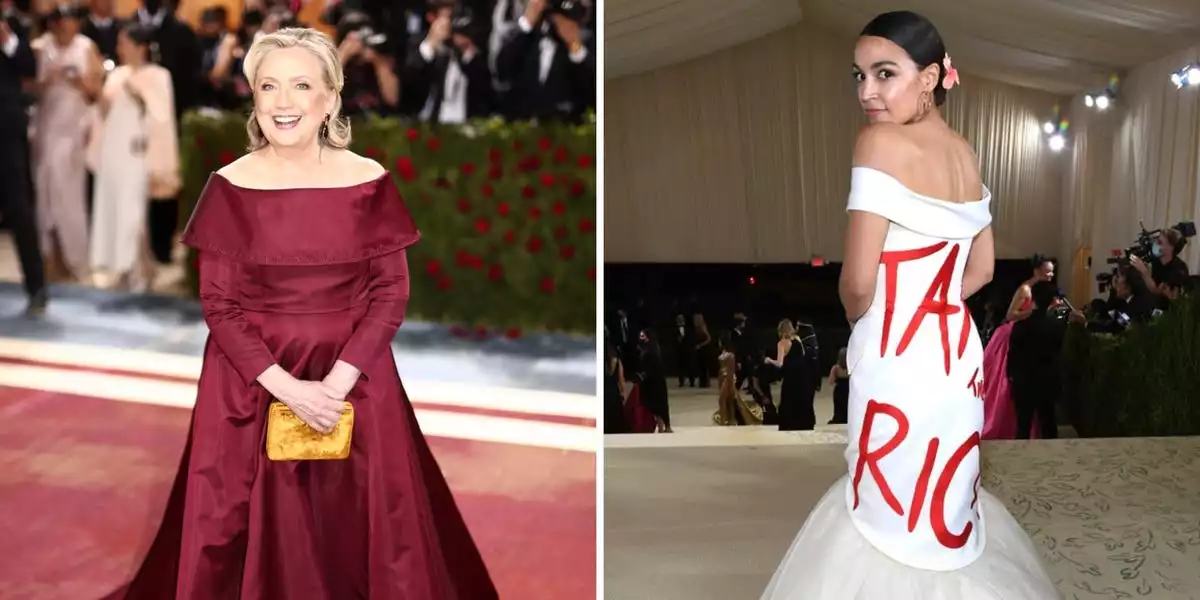

The Met Gala as a modern instrument of political capital and cultural soft power
The Met Gala—formally a fundraising benefit for the Metropolitan Museum of Art’s Costume Institute—has steadily matured into something closer to a global influence platform than a conventional charity event. Its red carpet is no longer merely a runway for couture; it is a high-visibility arena where political identity, cultural legitimacy, and elite-network signaling are performed in a single frame.
That evolution is visible in the guest list itself. Since Hillary Clinton’s 2001 appearance, elected officials and public office-holders have increasingly treated the gala as a venue for soft power projection—a way to communicate values and affiliations without a podium. Over the years, figures such as Donald and Melania Trump, Michael Bloomberg, Eric Adams, Mitt Romney, and Carolyn Maloney have appeared alongside entertainment and fashion’s most bankable names. Each attendance decision carries interpretive weight: it signals comfort operating within cultural institutions, proximity to donor ecosystems, and fluency in the language of prestige.
The Met Gala’s exclusivity—curated under Anna Wintour’s invitation regime—functions as a form of reputational leverage. For politicians, the event offers a rare blend of controlled access and maximal exposure: a tightly managed guest environment paired with near-unlimited downstream amplification. In practical terms, it is a stage where a public figure can accrue brand equity—appearing cosmopolitan, culturally engaged, and networked—without delivering a single policy speech.
Couture as messaging: when wardrobe becomes a policy headline
The most consequential shift is not simply that politicians attend, but that they increasingly arrive with deliberate narrative intent. The Met Gala has become a place where clothing can be engineered to behave like a campaign asset—compressing ideology into a photograph and distributing it at the speed of social media.
No example better captures this than Alexandria Ocasio-Cortez’s “Tax the Rich” dress, which demonstrated how a fashion moment can become a policy meme, a fundraising prompt, and a partisan Rorschach test simultaneously. Meanwhile, more traditional signifiers—flag pins, patriotic motifs, or diplomatic symbolism—have long served as subtle cues about allegiance, worldview, and constituency alignment. The point is not that the Met Gala is “political” in a narrow sense; it is that it has become a high-bandwidth communications channel where symbolism can outperform speeches in reach and recall.
This is where the gala’s role in political branding becomes structurally important:
- Earned media at scale: A single red-carpet image can generate attention that rivals or exceeds paid campaign advertising in cost efficiency.
- Lifestyle marketing for public officials: Politicians increasingly borrow tactics from consumer brands—visual identity, narrative consistency, and audience segmentation.
- Cultural diplomacy by proximity: Attendance signals alignment with major cultural institutions and the philanthropic class, a form of legitimacy that travels internationally.
Yet the same mechanics that make the Met Gala powerful also make it volatile. When advocacy is worn, it is also audited—by voters, journalists, watchdogs, and opponents. The scrutiny around Ocasio-Cortez’s payments and the Office of Congressional Ethics review illustrates a broader reality: fashion-based messaging can elevate a cause, but it can also trigger questions about sponsorship, gifts, and compliance.
The business model behind the spectacle: philanthropy, luxury marketing, and institutional survival
For the Metropolitan Museum of Art’s Costume Institute, the Met Gala is not a cultural sideshow—it is an economic engine. Arts institutions face persistent funding pressure, and high-profile philanthropy has become a competitive marketplace. The gala’s genius lies in how it outsources marketing costs to a network of fashion houses, sponsors, and celebrity talent, while converting attention into donations.
Luxury brands participate because the gala functions as experiential marketing with global distribution. Custom couture worn by a high-profile attendee is not just craftsmanship; it is a brand narrative delivered through celebrity association, editorial coverage, and social engagement. The relationship becomes symbiotic:
- The institution gains fundraising power and relevance.
- Fashion houses gain prestige, visibility, and downstream demand.
- Political attendees gain cultural capital and message reach.
This triangulation—politics, commerce, and culture—is increasingly characteristic of modern influence systems. The Met Gala is a case study in how institutions monetize attention while maintaining the aura of mission-driven philanthropy. It also reveals the delicate balancing act required to preserve credibility: a politically diverse guest list can reduce perceptions of partisanship, but it also invites competing ideological interpretations of the same event.
Technology’s multiplier effect: analytics, AI, and the future of hybrid influence events
What truly transformed the Met Gala from elite gathering to global communications infrastructure is technological amplification. Social platforms convert red-carpet moments into measurable assets: engagement metrics, sentiment analysis, share velocity, and hashtag performance turn fashion into data. For luxury marketers and political strategists alike, the gala now produces actionable intelligence about audience reaction—what resonates, what polarizes, and what travels across demographics.
Behind the scenes, the same ecosystem is increasingly shaped by AI-enabled tools:
- Trend forecasting to anticipate which aesthetics will dominate coverage cycles
- Image recognition and performance benchmarking to compare looks and narratives in real time
- Scenario modeling to assess reputational risk before a message hits the carpet
Looking ahead, the next competitive frontier is likely hybridization. As AR/VR experiences mature, institutions may extend gala access through digital layers—broadening donor pools while preserving exclusivity in new forms. Tokenized access, digital collectibles, or limited virtual “tickets” could create additional revenue lines, though they would also introduce new governance questions around valuation, disclosure, and equity.
The Met Gala’s deeper significance is that it previews a world where political communication increasingly behaves like brand communication, and where cultural institutions operate as both mission-driven organizations and sophisticated media enterprises. In that environment, the winners will be those who can align symbolism with substance, monetize attention without eroding trust, and navigate the tightening intersection of ethics, influence, and spectacle.

 By
By
 By
By
 By
By
 By
By



 By
By