

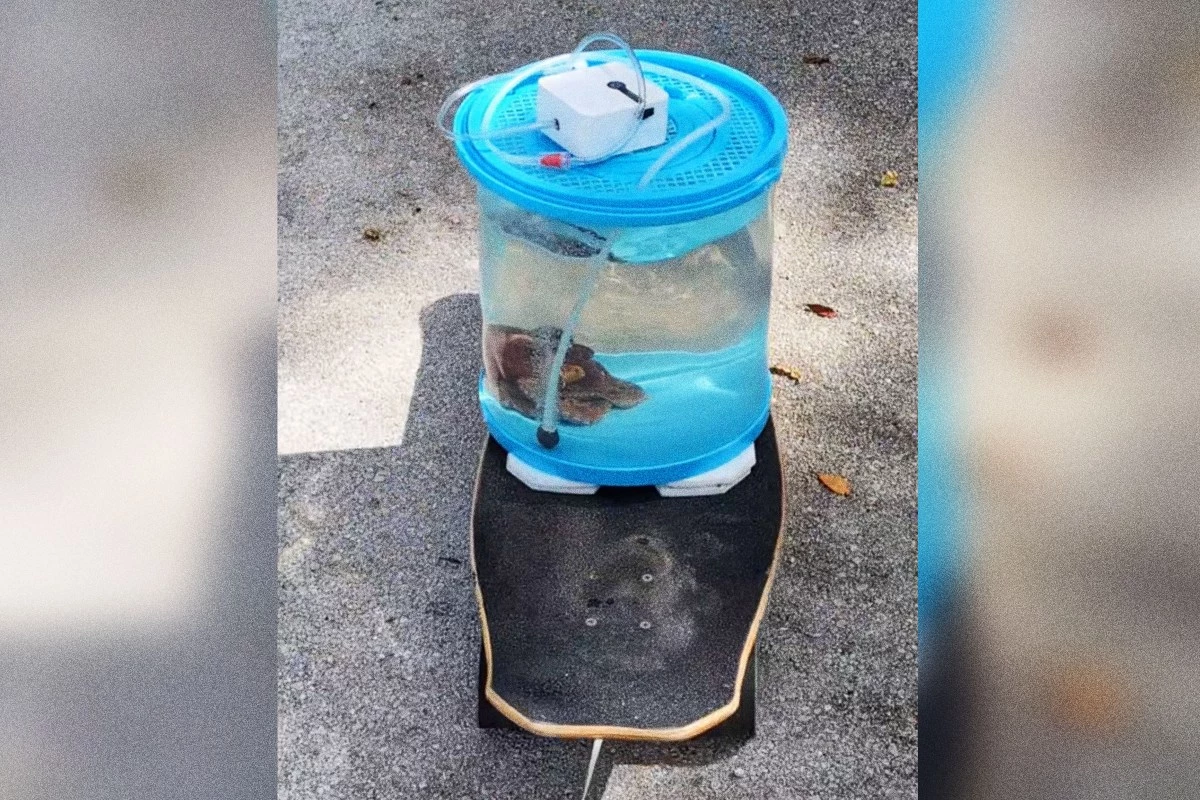

A viral octopus “walk” exposes the fault line between spectacle and stewardship
A TikTok clip of an influencer “walking” an octopus—transported in a water-filled tank mounted on a skateboard, accompanied by a family cat—has become a compact case study in how attention economics collides with animal-welfare expectations. The setup includes a wireless aerator to maintain oxygenation, signaling an attempt—at least performatively—to address basic life-support needs during a terrestrial outing. For many viewers, the scene reads as whimsical novelty; for marine biologists and animal-welfare advocates, it raises a more sobering question: Does the ability to keep an animal alive in transit equate to meeting its welfare needs?
Octopuses are not ornamental pets. They are widely recognized for high cognitive complexity, problem-solving, and sensitivity to environmental stressors—traits that make them compelling to observe but difficult to keep ethically in domestic settings. Critics point to documented stress behaviors in suboptimal captivity, including escape attempts and self-injury, as indicators that “enrichment” cannot be reduced to a change of scenery or a mobile tank. The controversy is less about one video than about what it represents: a growing cultural comfort with turning highly intelligent exotic animals into content props, and a parallel rise in public scrutiny over whether that comfort is justified.
Pet-tech meets cephalopod biology: innovation signals—and its limits
The mobile tank and wireless aeration are more than gimmicks; they hint at an emerging frontier in IoT-enabled pet care. In mainstream categories—dogs, cats, livestock—connected devices already support remote monitoring, automated feeding, and environmental controls. The octopus video suggests that similar thinking is migrating into niche markets: portable life-support systems, sensor-driven water-quality management, and “smart habitat” modules.
Yet the technical promise runs into biological reality. For cephalopods, welfare is not simply a matter of oxygenation and temperature stability. Their needs are multi-dimensional:
- Environmental complexity: spaces that allow exploration, hiding, and species-appropriate stimulation
- Physiological sensitivity: rapid stress responses to handling, vibration, light, and water-quality fluctuations
- Behavioral enrichment: challenges that engage cognition without inducing chronic stress
- Ethological fit: conditions that respect natural behaviors rather than forcing novelty for human entertainment
This is where the pet-tech narrative becomes strategically interesting. If companies pursue “smart exotic-pet habitats,” the differentiator will not be more connectivity—it will be welfare science embedded into product design. The most credible innovation pathway is collaborative: engineers working alongside marine biologists, veterinary specialists, and ethicists to define measurable welfare thresholds (water chemistry, noise/vibration exposure, enrichment protocols) rather than relying on aesthetics or influencer validation.
A second, adjacent technology storyline sits in R&D: octopus physiology continues to inspire soft robotics, bioinspired adhesives, and even ideas relevant to distributed neural-network architectures. The public’s fascination—when channeled responsibly—can support legitimate research and commercialization. But the same fascination, when channeled into impulsive ownership, risks normalizing practices that undermine welfare and conservation.
The business of virality: premium niches, reputational exposure, and demand shocks
From a market perspective, the clip underscores how quickly influencer culture can create micro-demand spikes for exotic animals and the specialized gear surrounding them. The willingness to invest in bespoke equipment—tanks, aerators, mobile platforms—signals a premium segment where affluent consumers pay for novelty and customization. That can expand categories such as:
- High-end aquarium fabrication and maintenance services
- Environmental-control hardware (aeration, filtration, monitoring)
- Enrichment products and consulting tailored to non-traditional species
But virality also introduces volatility. A single trend can amplify demand faster than regulators, legitimate breeders, or welfare educators can respond—creating openings for illicit wildlife trade and irresponsible sourcing. For businesses, the upside is real, but so are the liabilities:
- Compliance risk: shifting rules on sale, transport, and display of cephalopods
- Supply-chain opacity: difficulty verifying ethical sourcing and humane handling
- Brand risk: association with content perceived as exploitative or cruel
This is where ESG considerations become operational rather than rhetorical. Biodiversity and animal welfare are increasingly treated as material issues by consumers, activists, and—importantly—investors. Brands that sponsor creators, sell exotic-pet products, or operate adjacent businesses (aquaculture, hospitality, specialty retail) may find that yesterday’s “edgy” content becomes today’s reputational debt.
Regulation and ethical consumption: why this moment may accelerate policy change
The backlash—amplified by organizations such as PETA and echoed by scientists—signals a broader shift toward values-based evaluation of entertainment. Audiences are no longer judging content solely on novelty; they are increasingly weighing the moral and ecological footprint of what they watch and share. That shift tends to precede regulatory action, not follow it.
Jurisdictions with established animal-welfare frameworks and active policy communities—often cited in these debates include parts of the EU, California, and Japan—could move toward tighter oversight: licensing requirements, welfare benchmarks, restrictions on sale and display, or prohibitions for certain species. For executives and platform leaders, the strategic posture is clear:
- Pet-tech firms should design for welfare compliance from day one, treating regulation as a product requirement, not an obstacle.
- Brands and agencies should implement influencer due diligence—explicit animal-welfare standards, sourcing transparency, and content review protocols.
- Platforms may face pressure to label, limit, or demonetize content involving exotic animals unless welfare conditions are verifiable.
The deeper takeaway is that the internet’s appetite for spectacle is meeting a more demanding counterforce: ethical consumerism with real enforcement power. The octopus-on-a-skateboard may look like a fleeting meme, but it is also a signal flare—pointing to a future where technology, commerce, and culture are expected to treat intelligent non-human life not as a novelty, but as a responsibility.

 By
By


 By
By
 By
By


 By
By







