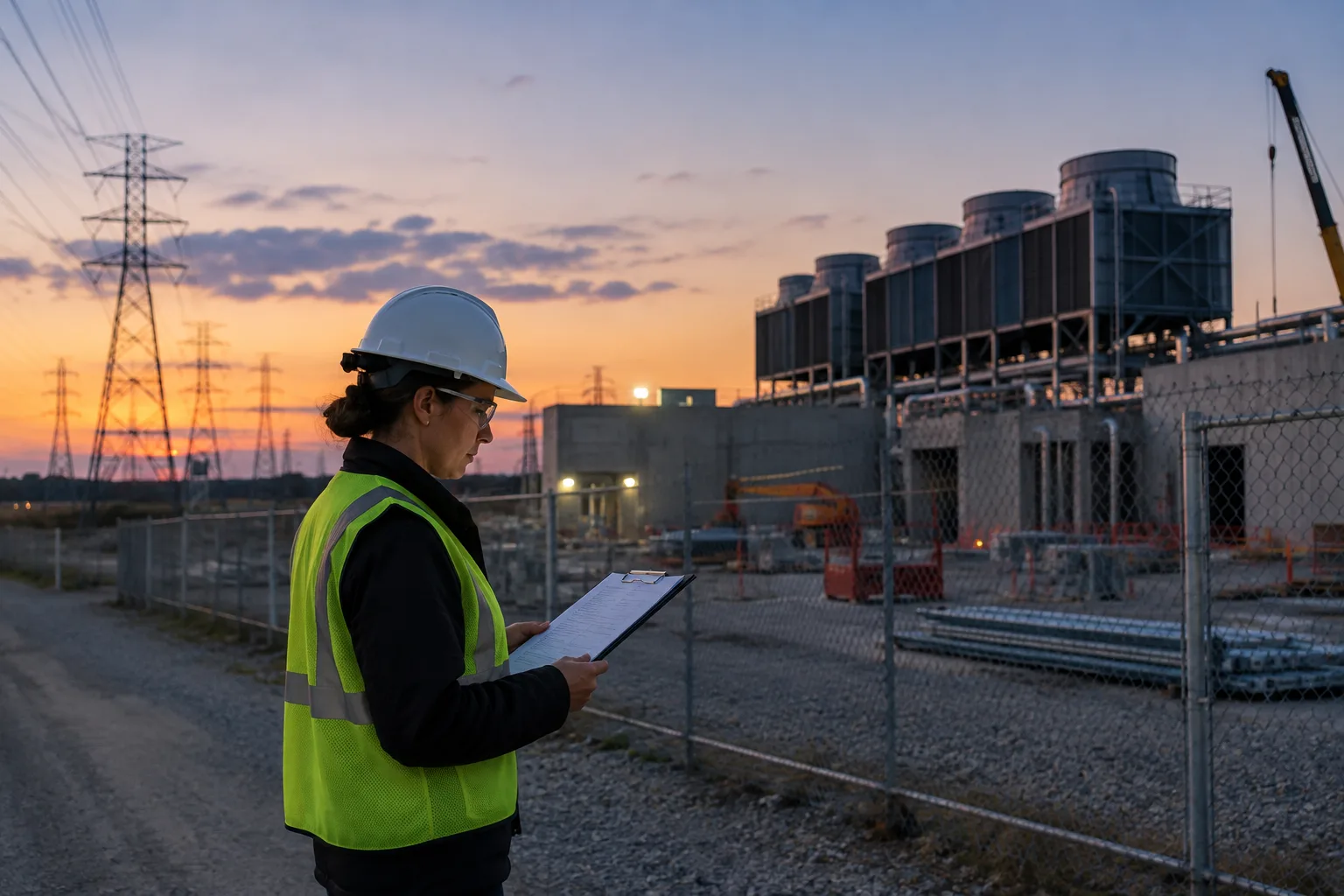

A hyperscale vision collides with the Great Salt Lake’s hard limits
Kevin O’Leary’s proposed Stratos Hyperscale Data Center near Utah’s Great Salt Lake has quickly become a defining test of how far—and how fast—AI-era infrastructure can expand in water-stressed regions. The original concept, spanning more than 40,000 acres, landed not as a conventional real-estate development but as a new class of critical infrastructure: a campus-scale computing and energy system whose externalities—water consumption, power draw, noise, and thermal emissions—are now inseparable from public policy.
Utah Senate President J. Stuart Adams pushed for a dramatic recalibration, calling for a 75% reduction in the project footprint amid heightened concern over the lake’s ongoing shrinkage. After initially resisting, O’Leary has now agreed to a 50% cut, removing roughly 19,430 acres, and has committed to two pivotal concessions:
- An independent scientific study focused on the facility’s thermal load
- A commitment to return any surplus water to the Great Salt Lake
Those moves have eased immediate political pressure, but the agreement reportedly remains in draft form, leaving the project’s social license contingent on follow-through, verification, and the durability of stakeholder trust. The episode underscores a broader reality: in 2026, hyperscale data centers are no longer judged solely by megawatts and latency—they are judged by hydrology, climate resilience, and governance credibility.
Cooling, thermal disclosure, and the new engineering frontier for AI data centers
Technologically, Stratos sits at the intersection of two powerful trends: the explosive growth of AI compute density and the tightening constraints on water and energy. A campus of this magnitude—even after a 50% reduction—would rank among the most thermally intensive computing installations in the world. That makes the promised independent thermal analysis more than a local concession; it could become a de facto benchmark for environmental disclosure in hyperscale operations.
Key technical implications are already emerging:
- Cooling architecture becomes a public-policy issue. Traditional evaporative cooling can be difficult to justify near a shrinking lake. Expect scrutiny of advanced approaches such as direct-to-chip liquid cooling and immersion cooling, alongside closed-loop designs that minimize consumptive use.
- Thermal load is not just heat—it is land-use and air-impact. Waste heat affects microclimates, noise profiles, and potentially local ecosystems. Independent modeling of heat dispersion and mitigation strategies may become a standard condition for permits in sensitive regions.
- Modularity is the only credible future-proofing strategy. With chip roadmaps moving toward 2nm-class nodes and specialized AI accelerators, operators must avoid “locking in” cooling and power assumptions that become obsolete. Modular, containerized compute “pods” can allow upgrades without expanding the water and power envelope.
Stratos also aims to capitalize on data gravity by positioning near Salt Lake City’s interconnection ecosystem. If realized, it could become a regional anchor for:
- AI training and inference
- Cloud and content delivery
- Latency-sensitive workloads such as industrial IoT, logistics optimization, and emerging autonomy applications across the Mountain West
The strategic bet is clear: proximity to network hubs can turn a data center into an economic magnet. The risk is equally clear: in a water-stressed basin, the most advanced cooling design is not a competitive advantage unless it is also auditable, explainable, and enforceable.
Water, capital, and the political economics of “social license to operate”
Financially, hyperscale campuses are defined by capital intensity and long-duration payback. Stratos implies multi-billion-dollar investment dynamics—often structured through infrastructure-style financing, including REIT-like vehicles, pension capital, and long-term debt. That places Utah’s policymakers in a familiar but sharpened dilemma: how to capture jobs, tax base, and digital infrastructure benefits without underwriting environmental risk or creating the conditions for stranded assets.
Three economic themes stand out.
- Water is now an economic asset class. The Great Salt Lake’s allocation pressures intersect agriculture, habitat preservation, and resource extraction. O’Leary’s pledge to return surplus water signals an emerging model where data centers negotiate water “offtakes,” recycling commitments, and potentially water credits—a conceptual cousin to renewable power-purchase agreements (PPAs).
- Host-state ROI must be stress-tested. Tax incentives and abatements can look attractive in the short term, but the long-term calculus shifts if regulatory constraints tighten or if climate-driven water scarcity forces operational curtailment.
- Transparency is becoming a financing requirement. Institutional investors increasingly audit for ESG performance, including water stress exposure and community impact. Independent verification—especially around thermal load and hydrology—can influence not only permits but also the cost of capital.
Politically, the project illustrates how quickly infrastructure debates can become identity-laden. O’Leary’s claims of foreign-funded opposition, including unsubstantiated references to Chinese backing, reflect a wider trend: hyperscale facilities are increasingly framed through a national-security and sovereignty lens, touching concerns about critical infrastructure resilience, cyber risk, and supply-chain dependencies. Even when such claims do not materially change permitting, they can harden positions, complicate negotiations, and raise the reputational stakes for all parties.
The governance template taking shape: verification, phased buildouts, and enforceable trade-offs
The most consequential outcome of the Stratos negotiations may be procedural rather than technical: a blueprint for how mega-scale data center projects earn permission to operate in environmentally constrained regions. The emerging template points toward local consent frameworks with real leverage, where communities and legislatures can demand measurable concessions before construction proceeds.
Practical mechanisms likely to define the next phase include:
- Third-party environmental and hydrological reviews as standard preconditions, not optional goodwill gestures
- Phased deployment—breaking the campus into smaller “pods” tied to environmental milestones and community benefits agreements
- Digital twin simulations to make thermal dispersion, water flows, and mitigation plans legible to non-specialists, reducing mistrust driven by abstraction
- Contractual water-return and recycling guarantees, with monitoring and enforcement provisions that survive leadership changes and market cycles
- ESG-linked incentives that tie executive and operator performance to verifiable outcomes such as net water impact, renewable integration, and local workforce development
Stratos is now less a single project than a live negotiation over what the AI economy is allowed to cost—ecologically, politically, and socially. If the independent thermal study and water-return commitments become enforceable realities rather than draft-language aspirations, Utah could end up hosting not just a hyperscale campus, but a replicable governance model for building the next generation of compute infrastructure where natural limits are no longer negotiable.

 By
By
 By
By


 By
By
 By
By
 By
By
 By
By