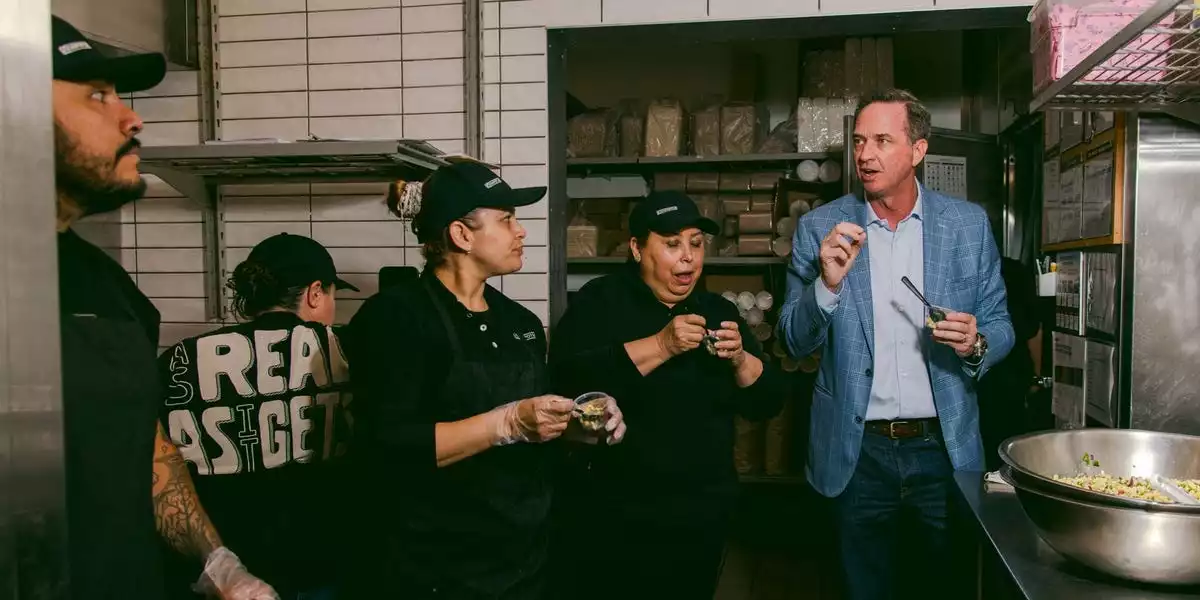

The “uncomfortable shift” as a leadership signal in modern quick-service restaurants
Jason Kidd’s account of rising to Chief Operating Officer at Chipotle Mexican Grill—by repeatedly volunteering for the least glamorous work—lands as more than career advice. It reads like a field manual for how leadership credibility is built in retail and quick-service restaurant (QSR) operations, where performance is ultimately decided by thousands of small, time-sensitive decisions made under pressure.
The core of Kidd’s message is straightforward: saying “yes” to overnight shifts, early-morning prep, and cross-functional tasks accelerated his promotions and expanded his understanding of how the business truly works. Yet the deeper implication is strategic: in service businesses, the “hard shifts” are not peripheral. They are where constraints reveal themselves—labor availability, food safety, throughput, demand spikes, equipment downtime, and customer experience friction.
For organizations like Chipotle operating at scale, leaders who have lived those constraints tend to develop a practical operating intuition that can’t be replicated through classroom training alone. That intuition becomes especially valuable as QSR models grow more complex—spanning in-store execution, digital ordering, delivery logistics, and data-driven planning.
Talent as strategic capital amid wage inflation and labor scarcity
Kidd’s narrative aligns with a resource-based view of talent: competitive advantage often comes from capabilities that are difficult for rivals to copy. In restaurants, one of the hardest-to-replicate assets is tacit operational knowledge—the kind acquired by working the shifts others avoid and learning how the system behaves when it’s stressed.
This matters in today’s macro environment:
- Labor market tightness and wage inflation raise the cost of mis-hires, churn, and undertrained managers.
- Margin compression in QSR makes operational mistakes more expensive—waste, overtime, service failures, and lost loyalty can quickly compound.
- Rising consumer expectations—speed, accuracy, and consistent quality—leave less room for learning on the job in public view.
Against that backdrop, “volunteerism” is not just an individual differentiator; it can be an organizational hedge. When high-potential managers rotate through difficult roles early, companies reduce the risk of building leadership layers that understand dashboards but not the underlying work. Kidd’s emphasis on ownership and communication also speaks to retention: employees are more likely to stay when they see leaders who understand their reality and can remove obstacles rather than merely enforce targets.
There is also an opportunity-cost critique embedded in his experience. Traditional management development in retail and restaurants often relies on predictable rotations—frequently day-shift-heavy—creating knowledge silos. A more flexible approach produces multiskilled leaders who can flex across breakfast prep, lunch rush throughput, and evening close without adding headcount, a direct response to labor scarcity and volatile demand.
Operational intelligence meets digital transformation in the Chipotle model
Chipotle, like many digitally mature restaurant brands, is increasingly defined by the integration of physical execution with technology: mobile ordering, loyalty ecosystems, delivery coordination, inventory forecasting, and automated or semi-automated kitchen tools. In that environment, Kidd’s “sweat the small stuff” philosophy becomes a form of digital readiness.
Cross-functional exposure creates managers who can connect cause and effect across the stack:
- A prep-line bottleneck is not just a staffing issue; it can cascade into digital order delays, delivery timeouts, and customer support load.
- Inventory variance is not just shrink; it can degrade forecast accuracy, distort replenishment signals, and trigger stockouts that harm conversion in-app.
- A point-of-sale disruption is not just an IT ticket; it’s a throughput event that requires real-time triage and customer recovery.
This is where Kidd’s focus on communication and “owning outcomes” intersects with agile operating principles now spreading beyond software. In digitally integrated restaurants, misalignment costs rise quickly because systems are tightly coupled. A small misunderstanding between kitchen execution and digital promise times can become a brand-level reliability problem.
His approach also echoes Kaizen, the lean discipline of continuous improvement through incremental refinements. The modern twist is that Kaizen increasingly operates alongside algorithmic management—labor scheduling tools, performance dashboards, and predictive analytics. The strongest operators tend to be those who can use data without becoming captive to it: applying human judgment to interpret anomalies, validate assumptions, and adjust processes when the model’s view of reality lags behind what’s happening on the floor.
What business and technology leaders can take from Kidd’s playbook
Kidd’s story is ultimately a commentary on how to build leaders for a hybrid economy—one where automation, data, and frontline execution are inseparable. For executives in QSR, retail, and other high-velocity service sectors, several practical implications stand out:
- Institutionalize cross-functional “hard shift” rotations: Make the least desirable assignments a formal part of leadership development, not an informal test of grit. Track cross-functional mastery as a first-class metric alongside sales and labor KPIs.
- Tie talent pipelines to the technology roadmap: If the business is deploying AI forecasting, advanced CRM, or automated kitchen equipment, ensure future leaders have firsthand experience with the workflows those systems are meant to optimize. Adoption improves when operators understand the process beneath the interface.
- Build feedback loops that match operational tempo: Annual reviews are too slow for real-time service environments. Frequent, candid “feed-forward” communication—supported by mobile tools where appropriate—raises problem-solving velocity and reinforces accountability.
- Manage the automation–upskilling nexus deliberately: As routine tasks become automated, the premium shifts to employees who can diagnose issues, coordinate across functions, and make complex trade-offs under time pressure. The workforce must evolve from labor capacity to decision capacity.
Kidd’s emphasis on choosing the uncomfortable assignment reframes ambition as operational empathy—an insistence on understanding the business at its most demanding moments. In an era when restaurants are becoming software-mediated systems as much as physical ones, that kind of earned perspective is not nostalgia for “paying dues.” It is a pragmatic strategy for building leaders who can keep the brand’s promise when the line is long, the app is full, and the margin for error is gone.

 By
By
 By
By
 By
By

 By
By


 By
By