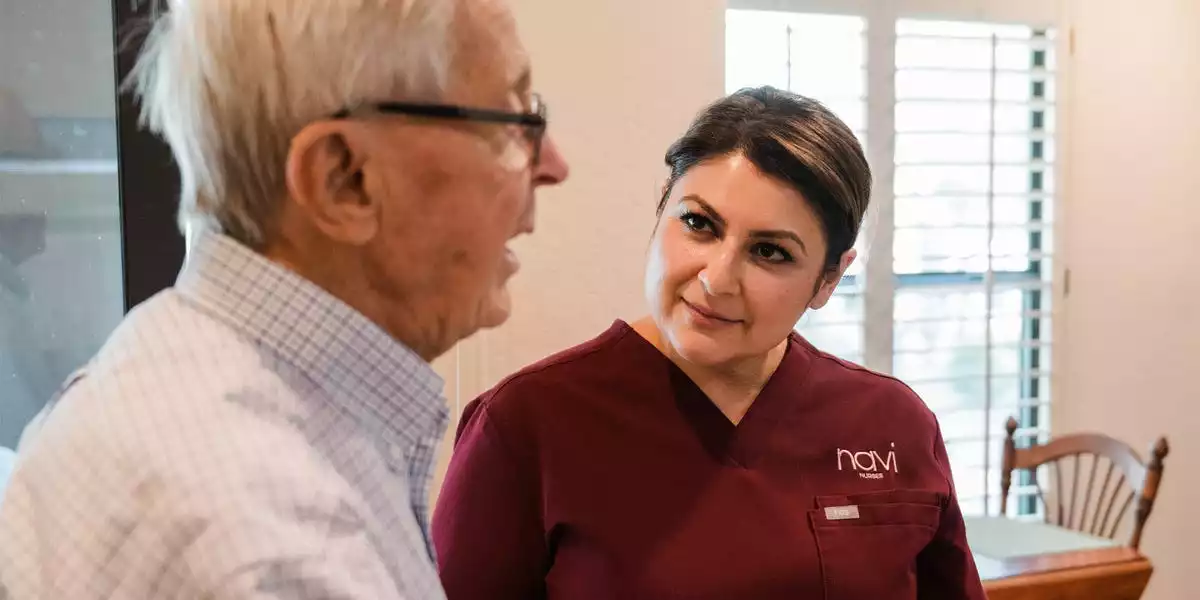

A nurse-led challenger emerges in the premium home health economy
Navi Nurses’ trajectory—80% annual growth and $7 million in revenue last year—signals more than a single founder’s success story. It reflects a widening market gap between traditional home health agencies optimized for volume and compliance, and a rising cohort of consumers seeking high-touch, continuity-driven, clinically rigorous care at home. CEO Jasmine Bhatti, shaped by her grandmother’s cancer journey and her own clinical training, has positioned the company as a premium, nurse-led alternative that treats trust and responsiveness as core product features, not marketing language.
The company’s early go-to-market approach is instructive for healthcare operators navigating high customer-acquisition costs. Bhatti began locally in Arizona in late 2020, initially using Facebook and then scaling through word-of-mouth, community partnerships, and volunteer engagement—a grassroots demand engine that tends to outperform paid channels in healthcare because it compounds credibility. From three nurses to more than 20, the growth pattern suggests a service model that is resonating at the community level, where referrals are often the most reliable proxy for perceived quality.
Just as notable is what Navi Nurses has *not* done. Bhatti has reportedly declined outside capital that could pressure the organization toward rapid expansion at the expense of care standards. In a sector where “growth-at-all-costs” has sometimes produced brittle operations and inconsistent patient experiences, the decision underscores a strategic bet: that patient-centric values can be a durable differentiator, and that disciplined scaling can be a competitive advantage rather than a constraint.
Building proprietary care infrastructure instead of renting it
A defining feature of Navi Nurses’ operating model is its decision to internalize software development and build a custom patient-management platform, rather than relying on off-the-shelf electronic health record (EHR) systems. This is a consequential move in home health, where many providers are constrained by rigid workflows, limited interoperability, and slow vendor roadmaps.
By owning the platform, Navi Nurses can iterate quickly on capabilities that directly affect patient experience and workforce efficiency, including:
- Scheduling and routing logic tailored to high-acuity, high-expectation home care
- Real-time nurse-to-patient matching, improving continuity and fit
- Telehealth integration that supports hybrid care without fragmenting the relationship
- Care coordination workflows designed around nurses’ real-world decision-making
The deeper strategic implication is data. A proprietary platform can capture granular care metrics—not just billing codes and visit notes, but operational signals that can reveal patterns in deterioration risk, adherence, and utilization. Over time, this can enable:
- Predictive analytics for readmission risk and escalation triggers
- Personalized care pathways that standardize quality without commoditizing care
- A defensible data asset that supports negotiations with payers and health systems
In a market increasingly shaped by value-based reimbursement, this kind of operational and clinical telemetry can become a moat—particularly if it translates into measurable outcomes like reduced hospitalizations, higher patient satisfaction, and better caregiver retention.
Labor economics, premium positioning, and the trust flywheel
Home health is constrained by a persistent reality: labor is both the largest cost and the primary determinant of quality. COVID-era shortages and wage inflation have intensified the challenge, pushing many providers into a tradeoff between staffing stability and margin preservation. Navi Nurses’ premium positioning suggests a different equation—one where higher wages and better working conditions can be supported by price differentiation, provided the service reliably delivers superior experience and outcomes.
The company’s emphasis on nurse empowerment through technology is especially relevant. Mobile-first tools that reduce administrative friction and improve coordination can raise productivity, but they also influence retention by making clinicians feel supported rather than surveilled. In a sector plagued by turnover, the ability to offer nurses:
- clearer schedules and expectations
- better matching with patients
- less duplicative documentation
- stronger clinical backing and escalation pathways
can translate into a more stable workforce—and a more consistent patient experience. That consistency, in turn, feeds the trust flywheel that drives referrals and community reputation.
Equally important is the company’s capital posture. By prioritizing capital efficiency and resisting dilution of its care model, Navi Nurses avoids a common pitfall among venture-backed healthcare services: scaling demand faster than operational maturity. In home care, where the “product” is delivered in thousands of unique living rooms rather than a controlled clinic environment, operational brittleness is quickly exposed.
Scaling beyond Arizona: value-based contracts, partnerships, and the platform question
Arizona has served as Navi Nurses’ proving ground, but the strategic questions sharpen as the company looks toward national and eventually international expansion. The home- and community-based services (HCBS) shift is real: payers and policymakers increasingly favor home settings to reduce institutional costs and prevent readmissions. That tailwind creates opportunity—but scaling premium, nurse-led care requires replicability without losing the high-touch ethos that made the model work.
Several pathways appear most consequential:
- Federated expansion: regional hubs with localized clinical leadership, governed by centralized technology and quality standards
- Standardized training and protocols: ensuring care consistency while preserving clinician judgment
- Value-based contracting: using outcomes data to pursue shared-savings or risk-adjusted agreements with Medicare Advantage plans and integrated delivery networks
- Adjacent service lines: post-acute coordination, chronic disease management, and remote monitoring partnerships that increase patient lifetime value and continuity
Finally, there is the strategic positioning question in an era of platform convergence. As insurers, health systems, and technology firms deepen their presence in home care, Navi Nurses’ proprietary platform and operational blueprint could make it an attractive partner—or acquisition target. The company’s leverage in any such conversation will hinge on whether it can continue converting its nurse-led philosophy into measurable outcomes at scale.
Navi Nurses is effectively testing a thesis that many healthcare incumbents have struggled to operationalize: human-centered care and business sustainability can reinforce each other when technology is built to serve clinicians, not replace them—and when growth is paced by quality rather than capital.


 By
By
 By
By
 By
By
 By
By

 By
By