

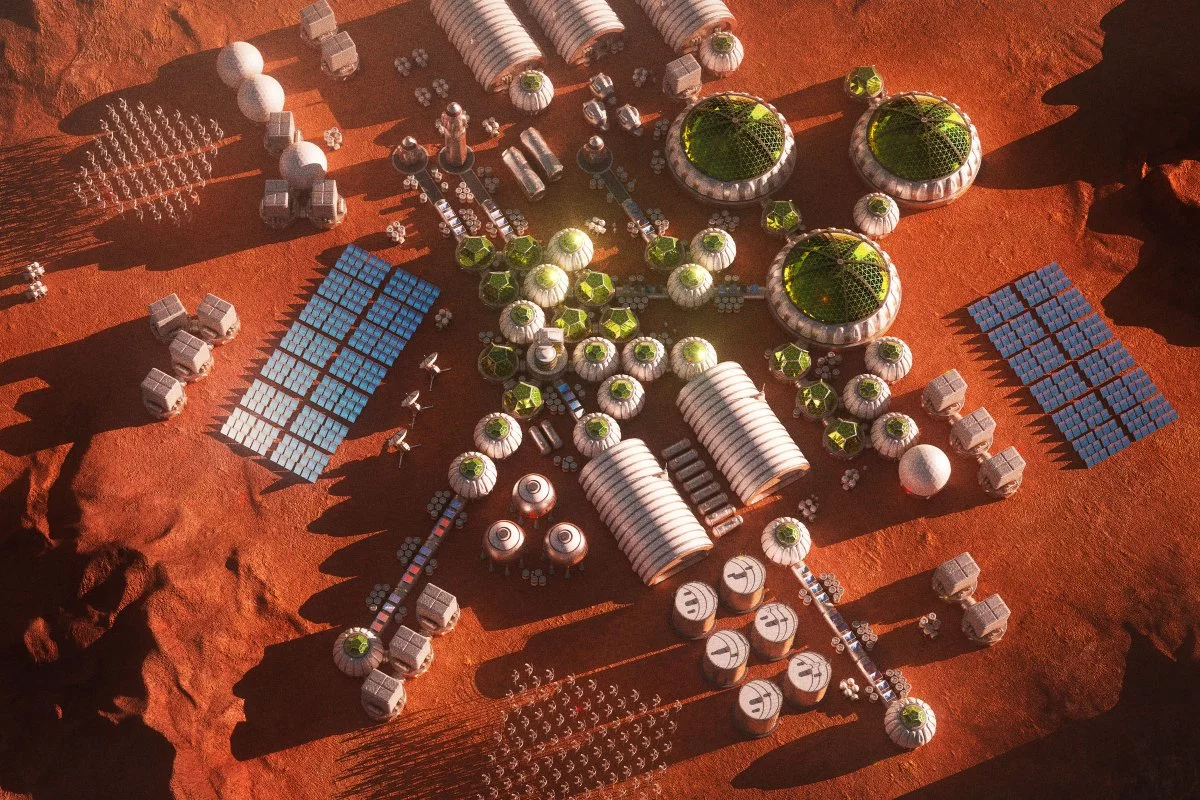

From sterile dust to living substrate: why fungal regolith remediation is a turning point for Mars agriculture
A persistent constraint on sustainable human settlement on Mars has been deceptively simple: the ground is not soil. Martian regolith is typically characterized as alkaline, nutrient-poor, and chemically hostile, with heavy metals and reactive compounds that complicate plant growth. Recent research reported in *Frontiers in Astronomy and Space Sciences* reframes that obstacle as an engineering opportunity—one that leans less on shipping life-support consumables from Earth and more on in situ biological transformation.
The central proposition is elegant: deploy specialized fungi to convert regolith into a plant-supporting medium by simultaneously addressing toxicity, nutrient availability, and stress tolerance. Among the leading candidates, Trichoderma species stand out for their practical versatility. They are widely studied on Earth for biocontrol and soil health, and in the Martian context they offer a compelling dual function:
- Detoxification via heavy-metal sequestration and immobilization
- Nutrient mobilization, notably through phosphate release, which is essential for plant metabolism and root development
This “two-for-one” biological behavior matters because every additional subsystem on Mars—chemical reactors, imported fertilizers, complex filtration—adds mass, failure points, and operational overhead. Fungal bioremediation suggests a path toward systems integration, where one organism performs multiple roles that would otherwise require separate hardware and supply chains.
Extremophile biology as infrastructure: resilience under radiation, desiccation, and thin air
Mars is not merely nutrient-poor; it is a stress test for life. High radiation exposure, extreme desiccation, low atmospheric pressure, and punishing temperature swings create a hostile environment for most terrestrial organisms. That is why the attention given to extremophiles such as Cryomyces antarcticus is strategically significant. Known for surviving in Antarctic desert analogs, this fungus represents more than a curiosity—it is a validated biological chassis for operating under Mars-like stressors.
The implication for space technology leaders is that biology is increasingly being treated as deployable infrastructure. Instead of asking whether an organism can survive, the more forward-leaning question becomes: what can it *do* reliably, and how can it be tuned? The near-term value lies in selecting organisms with proven hardiness; the longer-term value lies in pairing that resilience with the accelerating toolkit of synthetic biology, including gene editing and high-throughput screening for traits linked to radiation tolerance, metabolic efficiency, and nutrient cycling.
Equally important is the role of mycorrhizal associations—symbiotic networks between fungi and plant roots. The research highlights their potential to:
- Improve iron uptake, a common limiting factor in challenging substrates
- Reduce oxidative stress, which can rise under radiation and harsh environmental conditions
- Potentially enhance regolith structure, supporting aggregation and water retention—critical in a setting where liquid water is scarce and tightly managed
Taken together, extremophile fungi and mycorrhizal systems suggest a future where the “soil” on Mars is not imported or manufactured in a factory sense, but grown into functionality through living networks.
The economics of in situ biomanufacturing: shifting Mars missions from logistics to production
The business case is difficult to ignore. Launching mass to Mars remains extraordinarily expensive, and the summary’s reference point—costs on the order of $200,000 per kilogram—captures the strategic pressure to minimize imported consumables. If food production depends on Earth-supplied soil amendments, fertilizers, or growth media, then agriculture becomes a recurring logistics burden rather than a stabilizing capability.
This is where complementary work from the University of Bremen and the German Aerospace Center (DLR) becomes pivotal: an algae-based fertilizer synthesized exclusively from Martian materials. That result points to an emerging design philosophy for Mars settlement—original equipment manufacturing (OEM) on Mars, where local inputs are converted into life-support outputs. In practical terms, it hints at a closed-loop economy in which:
- Regolith becomes a feedstock rather than waste
- CO₂ from habitats and industrial processes becomes an input for biological production
- Nutrients are cycled through engineered organisms rather than shipped as consumables
For mission planners and investors, the shift is structural. It changes the risk profile from “can we afford to keep supplying this?” to “can we stabilize production locally?” It also changes architecture: smaller landers become more feasible, payload mass can be reallocated to high-value equipment, and surface operations can extend without proportional increases in resupply.
Competitive advantage, governance, and the next industrial stack for space settlement
These developments sit at the intersection of space technology, agri-tech, and synthetic biology, and that convergence carries strategic consequences. Actors that mature space-grade bio-agriculture first may gain outsized leverage in extraterrestrial supply chains—especially in any scenario where food security becomes the gating factor for longer missions and larger crews.
Several non-obvious second-order effects are already visible:
- Distributed biomanufacturing hubs: early Mars bio-labs designed for soil remediation and fertilizer production could evolve into multipurpose facilities producing bioplastics, pharmaceuticals, and structural biomaterials. This mirrors terrestrial Industry 4.0 trends toward on-demand microfactories—only with biology as the production engine.
- Human factors as performance infrastructure: “green” habitats are not merely aesthetic. The psychological benefits of living systems—routine, color, growth, and sensory variation—may translate into measurable improvements in crew cohesion and cognitive endurance, strengthening mission reliability in ways that are hard to model but costly to ignore.
- Intellectual property and planetary protection: proprietary fungal strains, fermentation protocols, and engineered consortia could become high-value IP. At the same time, planetary protection and biocontainment standards will shape what is permissible, when, and under whose oversight—turning governance into a parallel critical path alongside technical readiness.
What emerges from this body of work is a reframing of the Mars settlement challenge: rockets may deliver the first foothold, but biology may determine whether that foothold becomes a habitat, a farm, and eventually an economy. The most consequential breakthroughs may not be louder engines or larger landers, but quiet microbial systems that turn hostile dust into a living platform for human permanence.


 By
By
 By
By
 By
By


 By
By








