


Viral delivery-robot mishaps expose a deeper autonomy gap in public space
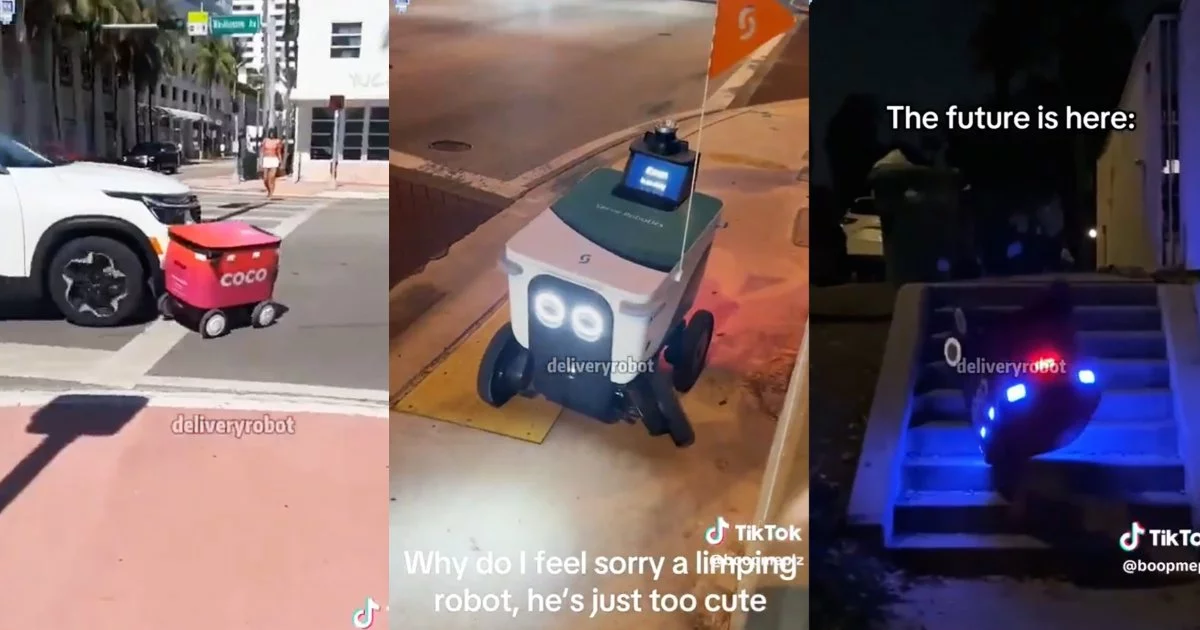
A widely circulated TikTok compilation from @BoopMePlz stitches together a sequence of delivery-robot failures that are, on the surface, easy to laugh at: a Coco Robotics unit struck and destroyed by a passing train; a Starship Technologies robot colliding with a marching band; multiple sidewalk bots dragged, toppled, or sent tumbling down stairs. The humor is real—but so is the signal.
These incidents illuminate a critical truth about last-mile delivery robots: they are not operating in controlled environments like warehouses, nor in heavily regulated domains like passenger vehicles. They are operating in the most complex, contested, and politically sensitive terrain a city has—the pedestrian right-of-way. Sidewalks and crossings are where accessibility needs, public safety expectations, and municipal liability converge. When a robot fails there, the consequences are not merely operational; they become civic.
What makes the compilation notable is not any single crash, but the pattern: repeated breakdowns in perception, navigation, and “social driving” behavior—precisely the capabilities required to coexist with people, pets, wheelchairs, strollers, cyclists, and unpredictable street geometry. In that sense, the viral montage functions like an informal public audit of a technology that has largely avoided sustained scrutiny.
Why sidewalks are harder than they look: sensors, edge cases, and urban unpredictability
Delivery robots typically rely on combinations of cameras, ultrasonic sensors, and sometimes LiDAR, paired with onboard compute and mapping. In ideal conditions, they can follow routes, avoid obstacles, and stop when confronted with uncertainty. The problem is that cities are not ideal conditions; they are a dense collection of exceptions.
Several technical fault lines are highlighted by the incidents:
- Perception limits in cluttered scenes: Crowds, reflective surfaces, low-contrast curbs, and variable lighting can degrade sensor reliability. A marching band is not just “a group of pedestrians”—it is a moving wall of irregular shapes, instruments, and synchronized motion.
- Staircases and grade changes as failure multipliers: Stairs, ramps, and broken sidewalks are common “gotchas” for small robots. A misclassification can turn a routine route into a tumble that risks injury or property damage.
- The long tail of edge cases: Train crossings, sudden street closures, construction cones, and erratic human behavior represent rare scenarios individually, but inevitable scenarios collectively. Viral clips often capture these “long tail” moments because they are both unusual and consequential.
- Deployment pressure outpacing learning cycles: Operators face incentives to scale pilots, win municipal approvals, and demonstrate unit economics. Yet autonomy improves through iterative exposure, careful incident review, and conservative expansion—an approach that can conflict with venture timelines and competitive positioning.
The result is a familiar autonomy paradox: the robot may perform well 95% of the time, but the remaining 5%—the moments that become TikToks—can dominate public perception and regulatory response.
The business case meets the public ledger: hidden costs, liability, and reputational risk
The commercial promise of autonomous last-mile delivery is straightforward: reduce labor dependency, address driver shortages, and lower per-drop costs in dense areas. But the TikTok compilation underscores how quickly savings can be offset by costs that don’t always appear in pitch decks.
Key economic and operational trade-offs include:
- Liability exposure and insurance ambiguity: When a robot damages property, blocks an ADA path, or contributes to an injury, responsibility can be diffuse—manufacturer, fleet operator, retailer partner, or even the city. Traditional auto insurance models fit poorly, and product liability can be slow and adversarial.
- Public infrastructure as an implicit subsidy: Sidewalks, curb ramps, and crossings are taxpayer-funded. Private fleets using them at scale raise questions about user fees, permitting, and equitable access—especially if robots impede pedestrian flow or require municipal enforcement.
- Asset utilization challenges: Robots that are idle, stuck, or frequently repaired become underutilized capital. A fleet’s economics depend on high uptime and predictable routing; viral failures hint at operational friction that can quietly erode margins.
- Brand upside versus brand risk: Retailers and logistics partners often treat robots as a differentiator—an innovation halo. Yet repeated public failures can invert that narrative, turning novelty into skepticism and raising doubts about safety culture.
In a media environment where a single clip can reach millions in hours, reputational risk becomes a measurable operational variable—one that can influence municipal permitting, partnership renewals, and consumer trust.
The governance vacuum: standards, permits, and the coming regulatory catch-up
Unlike self-driving cars—subject to extensive state-level attention and federal interest—sidewalk delivery robots have expanded in many jurisdictions through pilot programs, limited ordinances, or permissive ambiguity. The comparison to early micromobility (e-scooters) is instructive: rapid rollout first, patchwork regulation later, and public frustration in between.
The emerging policy questions are concrete and increasingly urgent:
- Who controls the right-of-way? Cities manage sidewalks for safety and accessibility, yet private fleets can effectively “occupy” that space without consistent rules on speed, yielding behavior, or operating hours.
- What incident data must be disclosed? Without standardized reporting, cities and the public lack a clear view of near-misses, collisions, and failure rates—making evidence-based policy difficult.
- What does “safe enough” mean? The sector lacks universally adopted benchmarks for obstacle avoidance, fail-safe behavior, remote intervention protocols, and accessibility compliance.
A pragmatic path forward is visible, and it will likely define which companies endure:
- Third-party safety audits and shared performance standards (potentially via ISO/IEEE-aligned frameworks)
- Human-in-the-loop operations where teleoperators can intervene across multiple units
- Geofenced operating zones and speed limits designed with pedestrian-first principles
- Municipal robotics councils that include planners, disability advocates, operators, and legal experts
- Insurance products tailored to autonomous ground robots, potentially with pooled risk models as fleets scale
The TikTok compilation may be entertainment, but it also functions as a public stress test—one that reveals how quickly autonomous delivery can shift from “cute convenience” to a governance issue. The next phase of last-mile robotics will be decided less by novelty and more by whether operators can prove, transparently and repeatedly, that autonomy can earn its place on the sidewalk.

 By
By
 By
By

 By
By
 By
By
 By
By
 By
By
 By
By







