

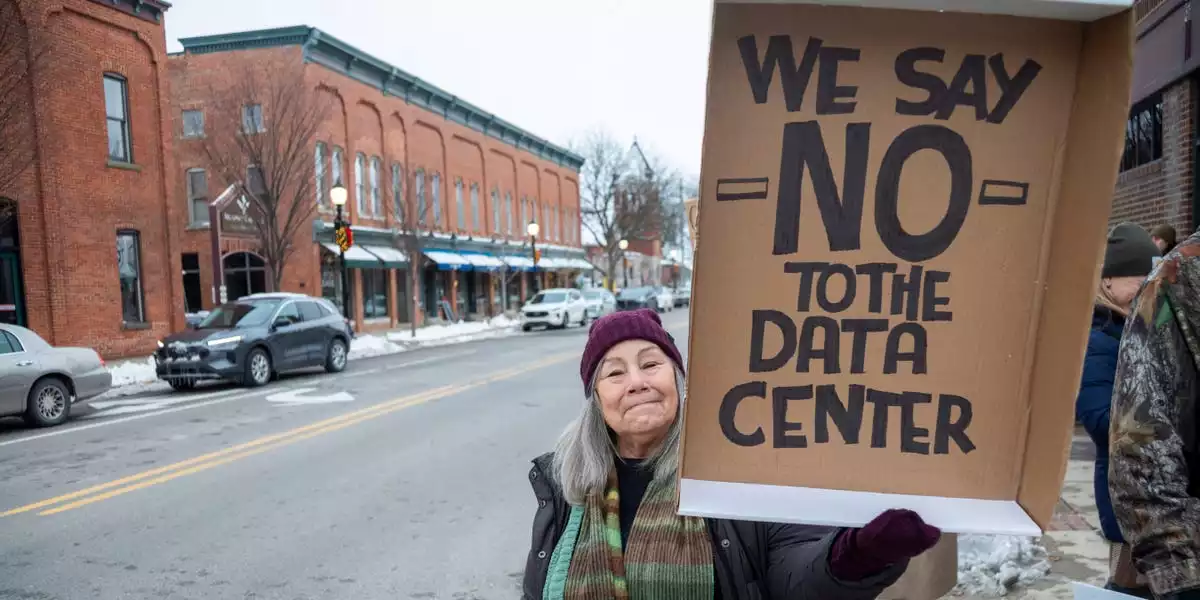

Hyperscale data centers meet the politics of place in the AI era
The United States’ hyperscale data center boom—fueled by cloud migration and the compute intensity of modern AI—has entered a more contentious phase. What once looked like a straightforward infrastructure expansion now resembles a negotiation over who bears the costs, who captures the benefits, and who gets to decide.
Local opposition has sharpened as projects scale from “industrial parks with servers” into regional power and water events. In Northern Virginia, the proposed Digital Gateway complex has become emblematic: lawsuits, calls for moratoriums, and heightened scrutiny have turned permitting into a prolonged political contest. The pushback is no longer confined to town halls; it is moving upward into statehouses and even Congress, where proposals such as a federal ban on new builds—however unlikely to advance in current form—signal that data centers are being reframed as a national policy issue rather than a purely local land-use matter.
For hyperscalers and colocation operators, the reputational risk is clear: if communities perceive data centers as extractive infrastructure—consuming electricity, water, and land while exporting profits—then the industry’s social license to operate weakens. The result is not just delayed projects, but a more structural threat: a patchwork of restrictions, incentive rollbacks, and ratepayer backlash that could reshape where and how AI infrastructure is built.
Grid strain, water intensity, and the carbon arithmetic of AI compute
At the heart of the conflict is a collision between 21st-century compute demand and 20th-century utility architecture. Hyperscale campuses can draw hundreds of megawatts, often clustering in the same regions for fiber access, tax policy, and proximity to customers. Yet transmission and distribution networks were not designed for such concentrated, fast-ramping loads—especially when demand spikes align with peak summer air-conditioning.
Key technical pressures are increasingly central to public debate:
- Electricity demand and rate impacts
– Large new loads can force utilities into accelerated investments in substations, transformers, and transmission capacity.
– Communities worry that these costs are “socialized” through rate cases, raising bills for households and small businesses that do not directly benefit from the facilities.
– In response, major technology companies have begun pledging not to shift infrastructure costs onto ratepayers—an important signal, but one that will be tested in regulatory detail.
- Water use and cooling choices
– Traditional evaporative cooling can consume millions of gallons per day, a flashpoint in water-stressed regions.
– Next-generation approaches—liquid immersion and direct-to-chip cooling—can materially reduce water intensity, in some cases by up to 90%, but require capital investment, operational changes, and supply-chain readiness.
- Carbon footprint and AI workloads
– Training frontier-scale models can generate substantial emissions depending on the grid mix and utilization profile.
– The industry’s most credible decarbonization tools—on-site renewables, virtual power purchase agreements (VPPAs), storage, and emerging green-hydrogen pilots—are advancing, but communities increasingly want proof that “clean energy claims” translate into local grid outcomes, not just accounting wins.
A subtle but important shift is underway: data centers are no longer judged only by Power Usage Effectiveness (PUE), but by a broader set of metrics—water intensity, marginal emissions, peak-load behavior, and grid upgrade obligations. This is where technical design becomes political: a facility that can flex demand, reduce water draw, and fund interconnection upgrades is easier to permit than one that appears to externalize those burdens.
Incentives under scrutiny and the emerging case for a sector-wide compact
For years, state and local governments competed aggressively for data center investment using tax abatements, property-tax relief, and favorable power arrangements. That bargain is now being revisited. Virginia’s reconsideration of incentives reflects a wider reality: as public awareness grows, elected officials face pressure to demonstrate that subsidies deliver measurable local value rather than simply subsidizing global cloud balance sheets.
The economic debate often hinges on a mismatch between visible externalities and diffuse benefits:
- Benefits frequently cited by operators include construction activity, some high-wage jobs, and increased tax base.
- Critics argue that permanent employment is limited relative to footprint, that specialized roles may be filled by imported talent, and that the community shoulders indirect costs through higher utility rates or constrained land use.
Complicating matters is competitive dynamics among hyperscalers. Rivalry between Google, Amazon, Microsoft, and others has historically discouraged a unified public strategy—each firm prefers to differentiate on sustainability claims, procurement scale, or community programs. Yet the political moment increasingly rewards collective action. Industry voices drawing parallels to SEMATECH, the 1980s semiconductor consortium, are pointing toward a pragmatic model: pool resources to establish shared standards, fund pre-competitive R&D, and present a coherent narrative about national importance.
A credible “data center compact” would likely need to include:
- Voluntary, auditable standards for PUE, water usage effectiveness, and greenhouse-gas disclosures
- Community benefit agreements tied to local workforce development, grid resilience, and transparent reporting
- Co-investment frameworks with utilities for substations, transmission corridors, and demand-response capabilities
Absent that, policymakers may default to blunt instruments—moratoriums, restrictive zoning, or incentive rollbacks—because they are politically legible even if economically inefficient.
National-security framing versus local consent: the next permitting battleground
AI geopolitics is pushing data centers into the realm of strategic infrastructure. Policymakers increasingly view domestic compute capacity as relevant to defense readiness, public health analytics, supply-chain resilience, and technological leadership. That framing could unlock faster permitting or “critical infrastructure” treatment—but only if paired with environmental guardrails that address local concerns.
The most durable path forward is likely neither unchecked expansion nor sweeping bans, but a more explicit trade: permission to build at scale in exchange for measurable reductions in water use, emissions, and grid stress—plus clearer local value creation. Data centers can even become grid assets if designed for flexibility, using AI-driven demand response and storage to smooth renewable intermittency rather than amplify peak demand.
The industry’s next phase will be defined less by how quickly it can pour concrete and more by how convincingly it can demonstrate that hyperscale growth is compatible with community welfare and climate constraints. In the AI era, compute may be strategic—but legitimacy is infrastructural, too.

 By
By
 By
By


 By
By

 By
By
 By
By







