

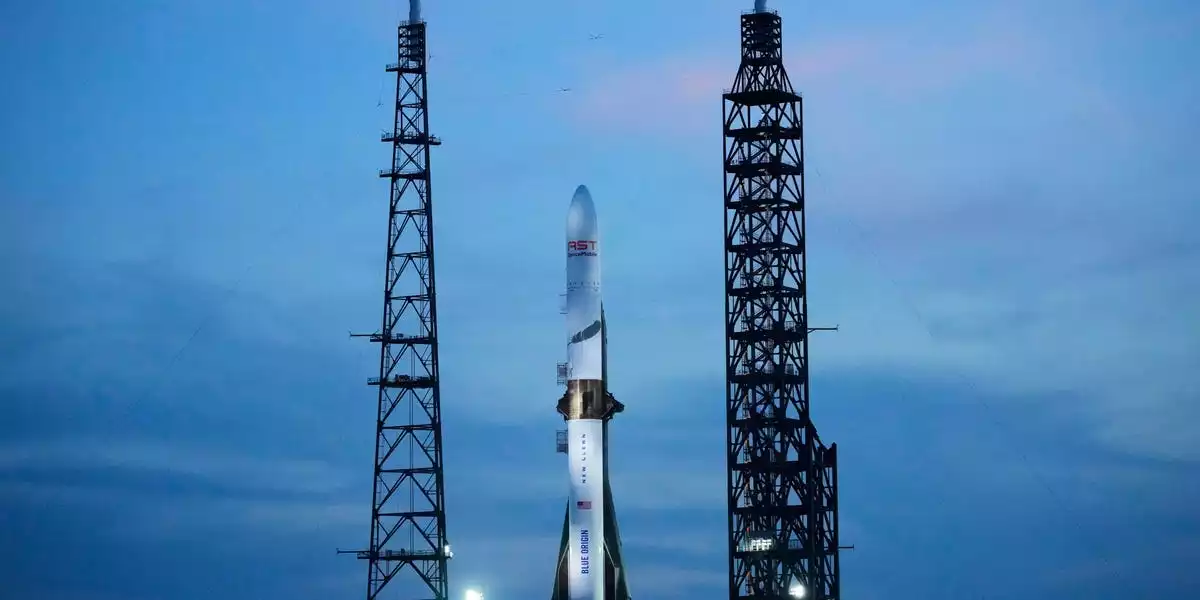

A static-fire fireball that reverberates beyond Cape Canaveral
The catastrophic anomaly during a routine static fire test of Blue Origin’s New Glenn heavy-lift rocket at Cape Canaveral Space Launch Complex 36 (SLC-36) is more than a dramatic visual event—it is a high-signal data point in the maturation curve of modern commercial heavy lift. The immediate facts are, by aerospace standards, the best-case version of a worst-case outcome: no injuries, no payload onboard, and an incident occurring in a ground-test regime designed precisely to surface failure modes before flight.
Yet the implications travel quickly. New Glenn is not merely another launch vehicle; it is a strategic pillar for Blue Origin’s ambitions in national security launch credibility, commercial market share, and the broader Bezos-linked ecosystem that includes Amazon’s Project Kuiper. Coming after a January 2025 maiden flight and an April mission that under-performed—an event that triggered an FAA inquiry now concluded—the SLC-36 explosion forces a hard reset on confidence, cadence, and near-term planning. Both Blue Origin and the FAA have opened investigations, while NASA has signaled close coordination to assess downstream impacts on Artemis-aligned objectives and longer-horizon lunar infrastructure goals.
Jeff Bezos’s public recommitment to rebuilding and returning New Glenn to flight matters symbolically, but the decisive work now is technical, procedural, and regulatory—measured in telemetry, metallurgy, and corrective action plans rather than rhetoric.
What static-fire failures often reveal about methalox propulsion and integration discipline
A static fire test is the closest controlled analogue to the stresses of launch: cryogenic propellant loading, ignition transients, combustion stability, turbomachinery dynamics, and software-mediated control loops all converge in a narrow window. When a vehicle fails here, it can point to a localized component defect—or to deeper systemic coupling across propulsion, avionics, and ground systems.
New Glenn’s architecture is closely associated with the BE-4 methalox engine family, a high-performance pathway that also compresses engineering margins. Methane-oxygen (“methalox”) propulsion offers operational advantages—cleaner combustion than kerosene and better deep-throttling characteristics than some alternatives—but it remains unforgiving during ignition and ramp-up, where small deviations can cascade.
Key technical vectors investigators will likely prioritize include:
- Ignition and start-sequence timing: transient pressure spikes, hard starts, or ignition instability can rapidly exceed design limits.
- Turbopump behavior and resonances: high-speed rotating machinery can encounter destructive vibration modes that only appear under specific thermal and flow conditions.
- Propellant feed and pressurization anomalies: cavitation, valve timing errors, or sensor drift can destabilize mixture ratios and chamber conditions.
- Software and control-loop interactions: modern engines are cyber-physical systems; a subtle sensor fault or filtering assumption can produce incorrect control responses at precisely the wrong moment.
- Interfaces between vehicle and ground-support equipment (GSE): umbilicals, quick-disconnects, purge systems, and flame-trench dynamics can contribute to failure propagation even when the initiating fault is onboard.
The incident also re-centers attention on pad resilience and recovery timelines. SLC-36’s ground infrastructure—flame management, blast protection, propellant handling, and isolation zones—will be audited not only for repair needs, but for whether the pad’s design assumptions align with the realities of repeated heavy-lift operations. In practice, the speed of return-to-test can hinge as much on GSE refurbishment and certification as on rocket rebuild.
Notably, the earlier orbital under-performance in April may or may not share root causes with this static-fire anomaly. Still, aerospace history shows that recurring anomalies across different phases (ground test vs. ascent) often trace back to common denominators: propulsion reliability, sensor integrity, or guidance, navigation, and control (GNC) interfaces where software and hardware meet.
Commercial and geopolitical stakes: Kuiper cadence, market confidence, and heavy-lift positioning
New Glenn has been positioned as a credible competitor to SpaceX’s Falcon Heavy and a complement/alternative in a market where customers increasingly demand high cadence plus high reliability. A pad-side explosion disrupts that narrative in the near term, because the market does not price launch services on aspiration—it prices them on demonstrated performance and schedule certainty.
The most immediate commercial pressure point is Project Kuiper, Amazon’s planned low-Earth-orbit broadband constellation. With dozens of satellites pre-manifested for New Glenn, any prolonged grounding or slow return-to-flight can trigger:
- Re-manifesting to other providers to protect regulatory milestones and service rollout targets
- Contract renegotiations that shift risk allocation, pricing, or delivery guarantees
- Insurance repricing, particularly if investigators identify systemic design or process issues rather than an isolated defect
- Customer confidence erosion, which can accelerate consolidation toward providers with deeper flight heritage
The ripple effects extend beyond launch services. Kuiper’s deployment tempo influences adjacent roadmaps in cloud-adjacent edge computing, connectivity partnerships, and long-horizon infrastructure planning. Even if AWS is not operationally dependent on Kuiper in the short term, markets tend to interpret delays as signals about execution risk across interconnected programs—fairly or not.
At the macro level, heavy-lift capacity is also a strategic asset. With China’s Long March evolution and Europe’s Ariane 6 timeline challenges reshaping the competitive landscape, any disruption to a U.S. heavy-lift entrant creates a narrow opening for international providers to court global satellite operators. Meanwhile, aerospace supply chains—high-temperature alloys, precision machining capacity, composites—remain exposed to inflationary and capacity constraints, raising the cost of extended test-and-redesign cycles.
The regulatory and programmatic path back: investigations, corrective actions, and credibility rebuilding
The FAA’s recently concluded inquiry into the April under-performance sets context: regulators have already demonstrated a willingness to scrutinize New Glenn’s readiness. After a static-fire explosion, the next phase will likely involve a more expansive review of test protocols, hazard analyses, and safety cases, potentially influencing how static-fire campaigns are structured across the industry.
NASA’s stated collaboration is equally consequential. Even if New Glenn is not the central launch backbone for Artemis, NASA’s posture signals that the agency is evaluating ecosystem risk—how commercial heavy-lift reliability, industrial capacity, and partner readiness affect lunar ambitions and future base logistics.
For Blue Origin, the credibility rebuild will depend on visible, disciplined actions more than messaging. The most confidence-restoring signals typically include:
- A transparent anomaly review process with clear fault-tree logic and corrective actions
- Independent technical participation (for example, propulsion and safety experts with cross-program experience)
- Demonstrable changes to hardware, software, or procedures, not simply re-testing the same configuration
- A realistic cadence reset, avoiding optimistic schedules that later slip and compound reputational damage
Spaceflight is still a domain where progress is purchased with rigor, repetition, and humility before physics. New Glenn’s static-fire failure is a setback—but it is also the kind of crucible event that clarifies whether a heavy-lift program is built to learn at speed, absorb shocks, and return with a safer, more resilient system that customers and regulators can trust.


 By
By
 By
By

 By
By
 By
By







