
Ukraine’s “agile defense” industrial model is rewriting the tempo of military innovation
Ukraine’s defense manufacturers are operating under a constraint that most peacetime procurement systems rarely face: the battlefield is both the test lab and the customer, and requirements can change in days, not years. Executives such as Achi of Ark Robotics and Gediminas Guoba of Granta Autonomy describe a dual mandate that would strain even the most mature industrial base—keep weapons tactically relevant through constant iteration while scaling output fast enough to matter operationally.
What is emerging is a distinctly modern production philosophy: high-frequency upgrades paired with scalable manufacturing, closer to software product cycles than traditional defense acquisition. In practice, this means:
- Dozens of minor updates per month, often driven by frontline feedback and adversary countermeasures
- Major platform revisions roughly twice a year, reflecting the reality that survivability and effectiveness can decay quickly in a fast-adapting conflict
- A deliberate shift away from bespoke, brittle designs toward systems that can be reconfigured without retooling entire factories
For Western allies—especially NATO members accustomed to multi-year certification and procurement timelines—Ukraine’s approach is becoming a live case study in how to compress the innovation-to-deployment loop without collapsing manufacturing discipline. The strategic signal is hard to miss: in contemporary warfare, R&D velocity is a combat multiplier.
Modular platforms and software-defined upgrades: the new center of gravity
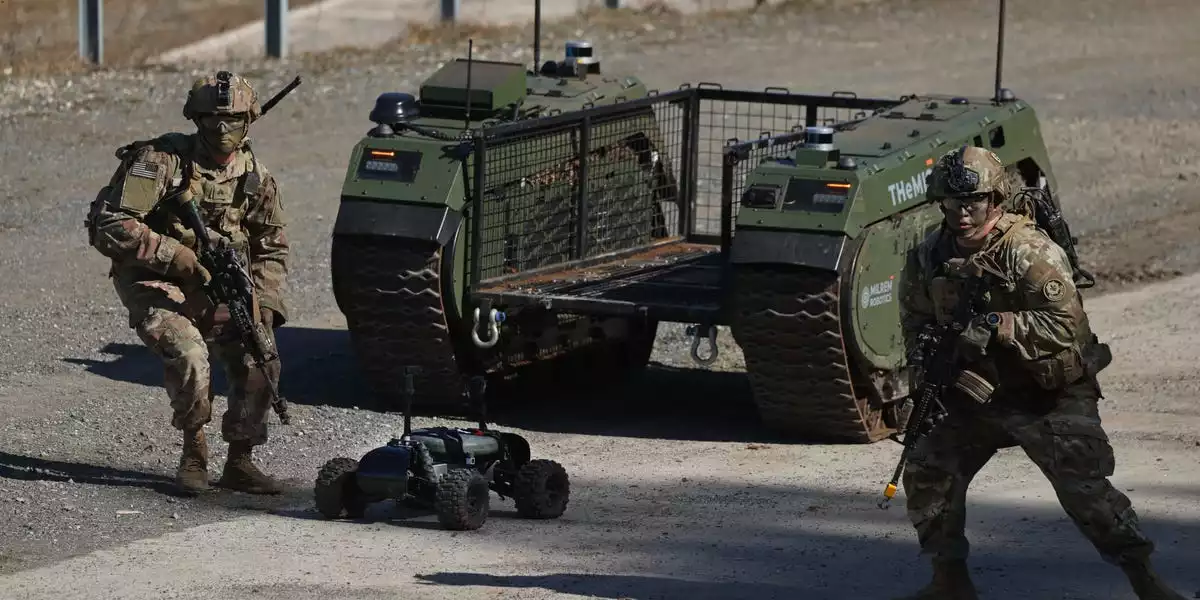
At the heart of this model is modularity, a design principle that turns a single base platform into many mission variants. Ark Robotics’ emphasis on a uniform uncrewed ground vehicle (UGV) chassis illustrates the logic: keep the mechanical core stable, and shift differentiation to swappable modules and software.
This architecture delivers several operational and industrial advantages:
- Rapid field customization: sensor suites, payloads, and weapon modules can be changed without redesigning the vehicle’s core mechanics
- Lower tooling risk: factories avoid overcommitting capital to specialized production lines that may be obsolete after the next tactical shift
- Faster learning cycles: feedback from deployment can translate into immediate design adjustments rather than waiting for the next procurement tranche
Equally consequential is the move toward software-defined capability. By decoupling hardware from mission and control software, firms can ship improvements as updates—target recognition, navigation logic, electronic counter-countermeasures—without physically recalling or rebuilding platforms. This is the defense analogue of DevSecOps, where continuous integration and rapid patching become central to survivability and performance.
For Western defense planners, the implication is structural: if capability increasingly resides in software, then certification regimes, cybersecurity standards, and sustainment contracts must evolve to support continuous change rather than episodic upgrades.
3D printing and flexible assembly lines: speed, resilience, and the human-in-the-loop advantage
Ukraine’s embrace of distributed additive manufacturing (3D printing) is not merely a prototyping convenience; it is a logistics and resilience strategy. Printing components at factories—and in some cases closer to forward operations—shrinks the distance between design, test, and deployment while reducing exposure to fragile supply routes.
Key industrial effects are already apparent:
- Shortened iteration loops: parts can be redesigned and produced quickly after field failures or new requirements
- Reduced dependency on long supply chains: local production mitigates delays and disruption risks
- A pathway to dual-use spillovers: techniques refined under wartime pressure can translate into commercial manufacturing—automotive, heavy equipment, and post-conflict reconstruction sectors—creating potential postwar revenue lines and exportable know-how
Just as notable is the counterintuitive production choice seen in firms like Frontline Robotics: preserving manual and semi-automated assembly cells rather than pursuing full automation. In a stable consumer market, automation is often the default efficiency play. In a volatile combat environment, however, flexibility can outperform pure throughput. Human-led assembly can be reconfigured quickly when specifications change weekly, and it can absorb design churn without forcing expensive reprogramming or retooling cycles.
This challenges a prevailing assumption in defense industrial modernization: that automation is always the end state. Ukraine’s experience suggests a more nuanced metric—adaptability per dollar invested, not automation for its own sake.
What Western allies and investors are learning: acquisition reform, capital strategy, and deterrence by adaptability
The Ukrainian “agile defense” model is now influencing how policymakers and capital markets think about defense readiness. The central tension—innovation versus scale—is being managed through modularity and software, but it also forces hard economic choices about where to invest and what to avoid.
Several strategic and economic lessons stand out:
- Resource allocation under uncertainty: firms must avoid overbuilding bespoke features that may be neutralized by new countermeasures, while also avoiding underinvestment that leaves troops without decisive capabilities
- Talent and budget rebalancing: modular hardware reduces sunk tooling costs, but raises the premium on software engineering, systems integration, data analytics, and supply-chain orchestration
- Sovereign manufacturing trade-offs: Ukraine’s localized production contrasts with Western reliance on globalized vendors; European policymakers are watching whether near-shoring critical components improves strategic autonomy even at higher unit costs
- Investor recalibration: venture and defense investors increasingly reward companies that demonstrate both rapid iteration and credible scaling, potentially redirecting capital toward “agile defense” startups and away from slower, platform-centric incumbents
The geopolitical dimension is equally sharp. By publicizing rapid update cadences and field-driven redesigns, Ukraine’s defense sector is effectively applying soft power pressure on allied procurement systems: if battlefield tempo is the benchmark, then bureaucratic tempo becomes a vulnerability.
Over time, this may reshape deterrence itself. Traditional deterrence often emphasizes inventory size and platform sophistication. The emerging alternative is deterrence through adaptability—the demonstrated ability to prototype, deploy, and iterate faster than an adversary can counter. In that world, the decisive advantage is not only what a military has today, but how quickly it can change what it has tomorrow.

 By
By
 By
By
 By
By
 By
By
 By
By
 By
By

 By
By