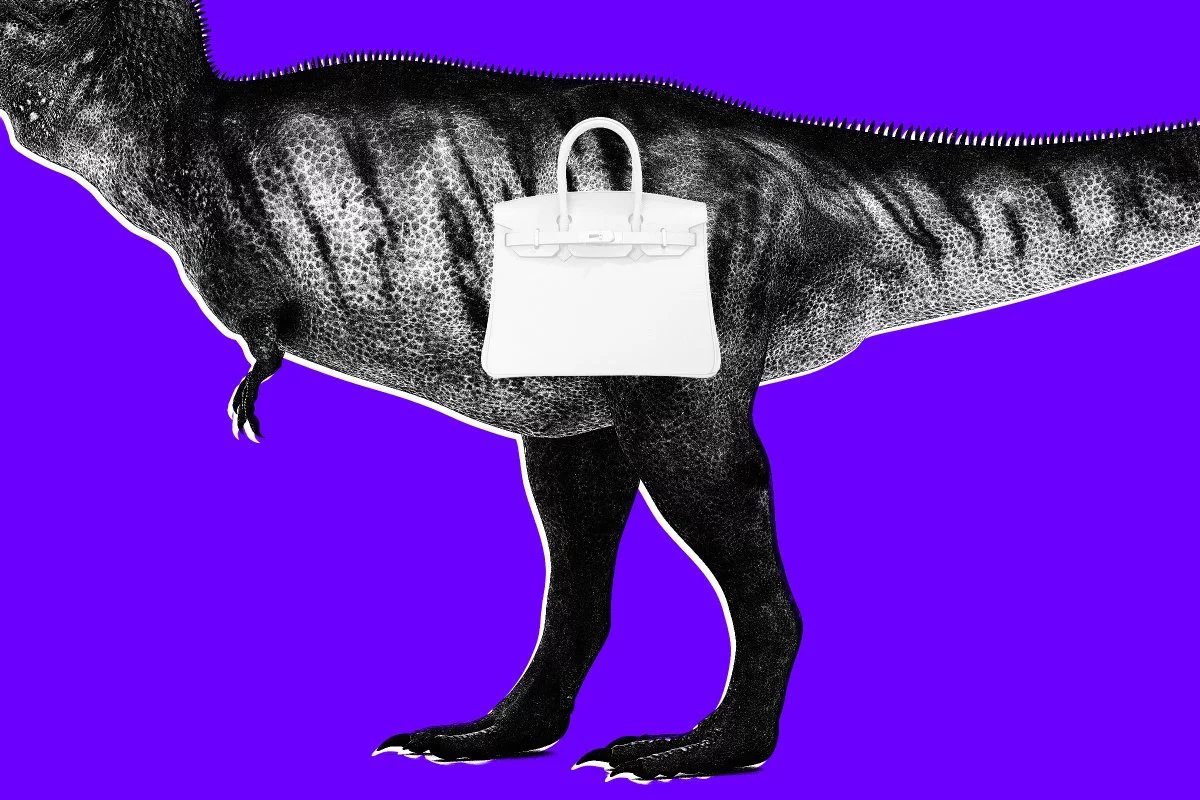

A $600,000 “T‑rex leather” handbag and the new economics of biotech storytelling
Polish luxury label Enfin Levé has ignited a global conversation by unveiling a handbag marketed as “lab-grown T‑rex leather,” positioned for a Paris auction at $600,000. The headline is engineered for maximum cultural velocity—part Jurassic fantasy, part Silicon Valley bio-optimism, part luxury-world theater. Yet the deeper significance is less about dinosaurs and more about how biofabrication, AI-driven protein design, and luxury pricing power are converging into a new category of high-margin, high-scrutiny goods.
At this price point, the handbag functions less like a conventional product and more like a collectible artifact—akin to a contemporary artwork or a one-off haute couture piece. The value proposition is not the square footage of material, but the narrative premium: a buyer is purchasing a story about scientific possibility, rarity, and cultural status. That is precisely why the “T‑rex” claim matters. In luxury, provenance is the product, and any ambiguity in provenance can become a direct threat to valuation.
This is also why the announcement has revived debate over a long-contested scientific episode: a 2005 paleontological claim that Tyrannosaurus rex fossils contained preserved soft tissue. Many scientists now argue the sample may have been bacterial biofilm rather than dinosaur collagen—an important distinction, because it reframes “dinosaur-derived” from plausible to promotional. The handbag’s market fate may ultimately hinge on how consumers, auction houses, and regulators interpret the boundary between inspired-by biology and biological authenticity.
AI-predicted collagen meets cellular agriculture: where innovation ends and inference begins
The reported production approach—fusing chicken-derived proteins with an AI-predicted T‑rex collagen sequence—sits at the frontier where computational biology can generate convincing molecular hypotheses faster than laboratories can validate them. In practical terms, experts’ critique that the end material is “more chicken than dinosaur” is not merely a quip; it highlights a structural tension in modern bioengineering: AI can infer what might have been, but it cannot retroactively prove what was without empirical reference material.
This episode mirrors broader advances in de novo protein design, where machine learning models trained on existing sequences can propose novel structures or approximate extinct ones. Tools in the orbit of AlphaFold-style prediction have normalized the idea that biology can be “designed,” not only discovered. But luxury marketing thrives on certainty—on the ability to say *this is that*—while AI-driven biology often operates in probabilities and best-fit reconstructions.
Key technical and credibility fault lines are emerging:
- Data provenance risk: If the training data is predominantly from extant species (notably Gallus gallus, chicken), the resulting “T‑rex-like” collagen may be statistically plausible yet biologically unprovable.
- Material identity ambiguity: Even if a sequence is engineered to resemble a hypothesized dinosaur collagen, the manufacturing substrate and expression system can dominate the final material properties.
- Validation gap: Without standardized third-party assays and disclosure norms, brands may be tempted to substitute scientific aesthetics for scientific substantiation.
Still, the underlying direction is real: lab-grown leather is moving from proof-of-concept to a platform. The “T‑rex” framing may be a spectacle, but it also signals a future where brands commission bespoke collagen profiles—not necessarily to resurrect extinct animals, but to create signature textures, durability characteristics, or sustainability claims that differentiate them in a crowded luxury landscape.
Luxury’s next battleground: authenticity, verification, and reputational downside
For luxury houses, the strategic question is no longer whether biofabricated materials will enter the market; it is how claims will be verified and how quickly reputational risk can propagate when verification is weak. A $600,000 auction lot amplifies that risk because it invites scrutiny from scientists, journalists, collectors, and competitors simultaneously.
If the “T‑rex leather” assertion is decisively debunked in the public mind, the consequences extend beyond one brand:
- Secondary-market volatility: Collectors and resellers may treat biotech-luxury goods as speculative assets whose value depends on narrative stability.
- Insurance and underwriting pressure: High-value items with contested provenance could face higher premiums or stricter documentation requirements.
- Consumer-protection exposure: Marketing language that implies biological authenticity may attract regulatory attention, especially in jurisdictions sensitive to misleading environmental or scientific claims.
This is where a new service layer becomes likely: biotech authentication for luxury supply chains. Expect growth in third-party validation using a mix of:
- Spectroscopy and biochemical assays to characterize protein composition and processing signatures
- Chain-of-custody documentation for cell lines, inputs, and production batches
- Digital traceability systems (potentially blockchain-based, though not necessarily) to support auditability rather than hype
In effect, the luxury sector may import a discipline long familiar to pharmaceuticals and aerospace: verification as a competitive advantage.
The bigger signal: lab-grown leather is maturing, and regulation will follow the market
The handbag’s most durable impact may be that it accelerates attention—capital, partnerships, and policy—toward lab-grown leather and engineered biomaterials. Even critics of the dinosaur framing often acknowledge the broader promise: reduced reliance on livestock supply chains, potential improvements in land use, and a pathway to materials with controlled properties. Yet the economics remain challenging. Today’s lab-grown leather costs are still far above conventional hides, and scaling depends on advances in bioreactor throughput, cell line stability, fermentation efficiency, and downstream processing.
For industry leaders, the strategic playbook is coming into focus:
- Partner early across sectors: Fashion groups aligning with biotech firms can share IP risk and shorten time-to-market.
- Standardize claims before regulators do: Voluntary disclosure and third-party review can pre-empt accusations of greenwashing or “authenticity theater.”
- Design for trust, not just novelty: In luxury, the most valuable innovation is the one that can be explained, audited, and defended under scrutiny.
The “T‑rex leather” handbag may ultimately be remembered less as a triumph of paleobiology than as a stress test for a new category: AI-assisted biofabricated luxury, where the material is engineered, the story is monetized, and credibility becomes the scarcest resource of all.

 By
By
 By
By

 By
By

 By
By
 By
By
 By
By