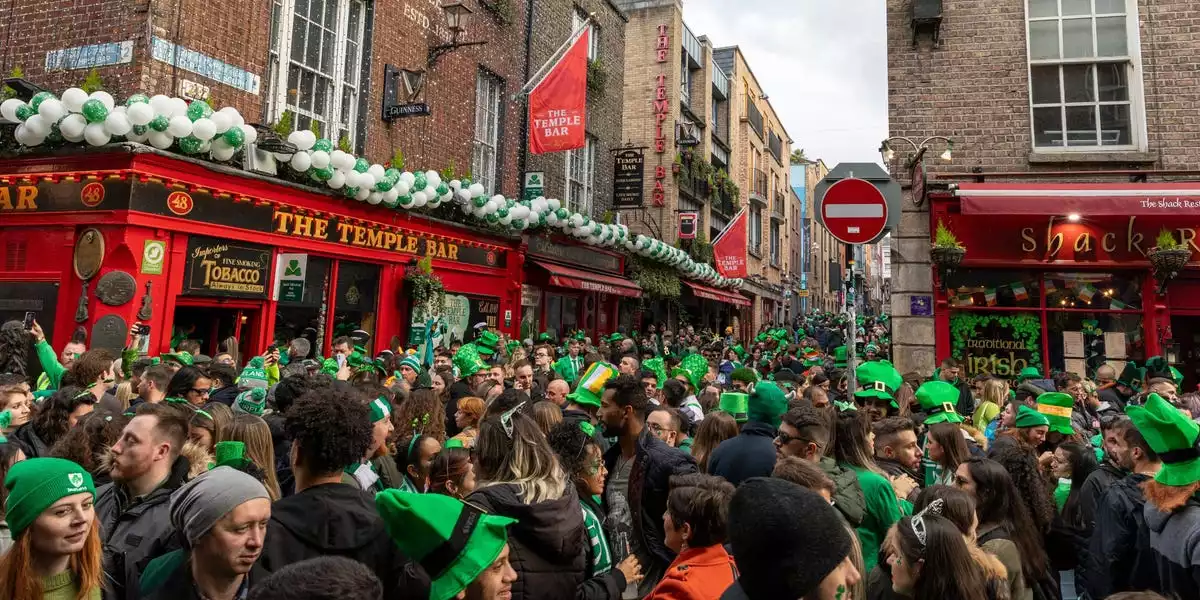

Dublin’s St. Patrick’s Day as a stress test for modern tourism economics
Amanda Shammas’s account of St. Patrick’s Day in Dublin reads less like a holiday recap and more like a live-fire exercise for event-driven tourism. Few calendar moments concentrate demand as intensely: flights fill, hotels spike, attractions sell out, and public space becomes a finite commodity. The result is a familiar pattern for global cities hosting marquee events—crowding, surge pricing, capacity bottlenecks, and elevated security risk—but with a sharper edge in a post-pandemic market still recalibrating staffing, infrastructure, and traveler expectations.
From a business and technology perspective, St. Patrick’s Day functions as a “flash demand” phenomenon where typical seasonality is temporarily replaced by a single-day gravitational pull. That pull doesn’t just raise prices; it exposes the weakest links in the visitor economy: fragmented ticketing systems, uneven real-time information, and limited tools for distributing footfall beyond the most famous streets and venues. Shammas’s pivot—watching the parade from an Airbnb rather than fighting for curb space—also signals a subtle shift in consumer behavior: when physical participation becomes too costly or risky, travelers increasingly choose hybrid or remote engagement without abandoning the event’s cultural value.
Surge pricing, inventory friction, and the trust gap in travel platforms
The economic logic of St. Patrick’s Day is straightforward: demand overwhelms supply, and dynamic pricing does what it is designed to do—allocate scarce inventory. Yet the traveler experience often hinges less on the price itself than on whether the purchase feels predictable, transparent, and reliable.
Shammas’s Guinness Storehouse ticketing failure is a telling example. When one member of a group cannot secure a slot, the issue isn’t merely inconvenience; it’s a breakdown in reservation integrity—the promise that inventory shown to consumers is accurate, synchronized, and fairly distributed across channels. In high-demand windows, even minor latency or channel fragmentation can cascade into missed experiences and reputational damage.
Key structural pressures revealed by these peak events include:
- Channel fragmentation: direct sales, third-party resellers, offline agents, and under-integrated APIs can create inconsistent availability and pricing.
- Real-time inventory limitations: systems that work under normal load may fail under surge conditions, producing “phantom availability” or checkout failures.
- Perceived value erosion: when travelers pay premium prices and still miss core attractions, the experience feels like overpayment—especially in an inflation-sensitive environment.
For operators, the commercial risk is not only lost revenue from a single ticket. It is the longer-term cost of diminished trust, which can push travelers toward alternatives—different cities, different attractions, or different modes of participation.
Crowd density and personal security: the overlooked technology opportunity
High-density celebrations predictably amplify petty crime. Shammas’s stolen phone underscores a recurring reality: crowds create cover, and major events concentrate distracted visitors carrying high-value devices. For city authorities and event organizers, safety is not just a policing issue; it is increasingly a data and systems challenge.
There is a growing case for integrated “crowd intelligence” that blends operational management with visitor protection:
- Real-time density monitoring using edge-AI video analytics to detect congestion and trigger interventions (route changes, barrier adjustments, timed entry).
- Geo-fenced alerts that notify visitors when they enter high-risk zones or when density thresholds are exceeded.
- Rapid-response service design that links reporting, device lock/wipe guidance, and insurance claims into a single workflow.
This is also where insurtech can move from a niche add-on to a mainstream travel feature. Micro-policies tailored to short-duration, high-density events—covering phone theft, medical incidents, or missed bookings—can be embedded at checkout. The strategic benefit is twofold: travelers gain confidence, and platforms gain a new revenue stream while reducing post-incident dissatisfaction.
Galway, “spillover tourism,” and the business case for destination diversification
One of the most commercially significant signals in Shammas’s narrative is the implicit recommendation to choose Galway over Dublin for a more accessible, authentic experience. This is not simply personal preference; it reflects a broader market trend toward tier-2 destinations that offer cultural richness without the same congestion premium.
For tourism boards and travel platforms, this is the logic of spillover tourism: when a flagship city hits capacity, adjacent regions can capture demand—if they are discoverable, bookable, and connected. The challenge is that many secondary destinations still lack the digital maturity to compete during peak moments, particularly around:
- Real-time reservations for attractions and dining
- Local mobility integration (shuttles, rail coordination, last-mile options)
- Event-aware recommendations that adapt to congestion and availability
This is where AI-enabled destination management becomes more than a buzzword. Forecasting engines that synthesize historical footfall, flight bookings, accommodation searches, and social sentiment can help cities and operators anticipate surges weeks ahead. Platforms can then nudge travelers toward alternatives based on live congestion signals and preference matching—turning what would be a degraded experience into a curated one.
Just as importantly, Shammas’s choice to watch the parade remotely points to a complementary pressure valve: hybrid physical-digital experiences. High-quality streaming, virtual tours, and bundled “in-person plus digital” packages can preserve engagement while reducing crowd load. For attractions, monetizing both channels can smooth revenue volatility and protect brand equity when on-site capacity is constrained.
St. Patrick’s Day in Dublin is ultimately a case study in how modern travel succeeds or fails at the intersection of pricing, platforms, and public space. The destinations that thrive will be those that treat peak events not as unavoidable chaos, but as predictable demand spikes—engineered through better forecasting, tighter reservation ecosystems, smarter crowd operations, and credible alternatives that keep the cultural promise intact even when the streets are full.

 By
By
 By
By
 By
By
 By
By


 By
By
 By
By