

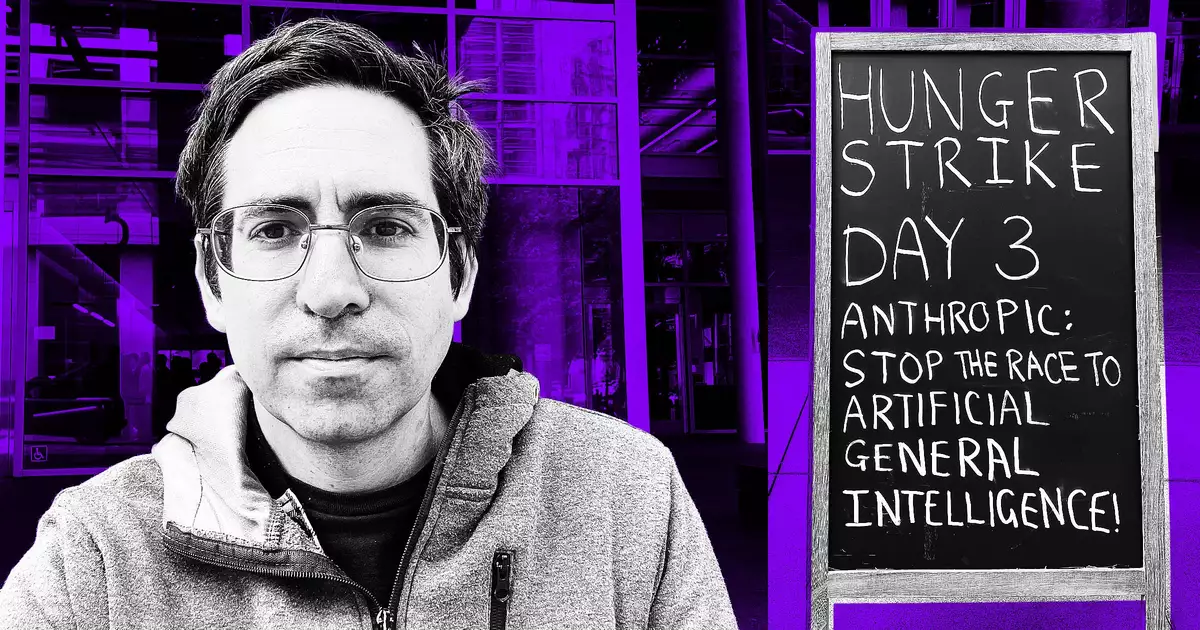

A Hunger Strike at the Gates: AGI Anxiety and the New Frontiers of Tech Accountability
Outside the glass-and-steel headquarters of Anthropic, a solitary protest has captured the attention of an industry accustomed to disruption but less familiar with dissent. Guido Reichstadter’s hunger strike—ostensibly a minor act—has become a catalyst, distilling the diffuse anxieties swirling around artificial general intelligence (AGI) into a single, undeniable image. In the shadow of Silicon Valley’s optimism, this protest signals a profound shift: the era of “move fast and break things” is colliding with a society increasingly unwilling to accept unmitigated technological acceleration.
From Margins to Mainstream: The Rise of Anti-AGI Mobilization
What began as a lone act of resistance has rapidly evolved into a node in a growing network of activist coalitions. Groups like StopAI and StopGenAI, drawing inspiration from the early environmental and anti-nuclear movements, are coalescing into a coordinated opposition. Their message is as urgent as it is unsettling: unchecked AGI research, they argue, risks not only existential threats but also more immediate harms—labor displacement, opaque governance, and the concentration of economic gains among a privileged few.
This activism is not merely rhetorical. Tactics are shifting from awareness campaigns to direct action: public records requests, shareholder resolutions, and even campus recruitment boycotts. The hunger strike, while symbolic, is a harbinger of more tactical obstruction to come—targeting data centers, chip supply chains, and other operational chokepoints. The historical parallel is instructive: just as early 2000s GMO protests outpaced scientific consensus to reshape consumer sentiment, today’s AI activism threatens to move faster than regulatory or industry adaptation.
The Strategic Calculus: Narratives, Economics, and the Battle for Legitimacy
Beneath the surface, a deeper contest is underway. Tech giants have framed AGI as a geopolitical inevitability—a new Cold War, where regulatory delay is tantamount to national decline. This narrative, critics contend, is not just self-serving but strategically potent, channeling capital, deterring oversight, and capturing lucrative defense contracts. Yet, as the hunger strike underscores, this framing is increasingly viewed with skepticism by regulators, investors, and labor advocates alike.
Several fault lines are emerging:
- Narrative Capital: With frontier model performance reaching diminishing returns, the story of imminent AGI now drives valuations and fundraising more than technical breakthroughs.
- Economic Tensions: Productivity gains from generative AI accrue to those who control intangible assets, while wage growth stagnates—a dynamic that risks fueling populist backlash and regulatory intervention.
- Reputational Risk: Public-facing protests introduce a new category of risk for R&D leaders, one that cannot be mitigated by technical alignment alone. The optics of a hunger strike are not easily countered by white papers or safety benchmarks.
The result is a landscape where social license—once an afterthought—is becoming a strategic imperative. Capital markets may soon price in a “social license discount,” penalizing firms that ignore equitable value distribution, much as high-carbon assets now face ESG-related headwinds.
The Road Ahead: Actionable Imperatives for the AI Ecosystem
As the AGI debate intensifies, the hunger strike at Anthropic is less an isolated incident than a signal flare for the entire sector. The implications are clear for stakeholders across the value chain:
- AI Vendors and Executives: Move beyond alignment rhetoric to implement tangible co-governance mechanisms—external audits, transparent compute disclosures, and models for sharing AI-driven productivity gains with workers. Prepare for activist-driven disruptions and integrate community relations into launch strategies.
- Enterprise Adopters: Factor social-license risk into vendor selection, alongside traditional privacy and IP concerns. Develop labor partnership frameworks to pre-empt workforce resistance and ensure sustainable productivity.
- Investors and Boards: Reassess valuation models to account for potential regulatory drag—compute caps, taxes, or outright bans. Monitor activist movements as leading indicators of policy shifts and capital reallocation.
- Policymakers: Shift from theoretical debates to enforceable standards: auditable data lineage, kinetic fail-safes, and tiered licensing tied to compute thresholds. Engage labor and civic groups in regulatory sandboxes to align incentives before adversarial dynamics become entrenched.
Fabled Sky Research notes that the hunger strike, while modest in scale, has succeeded in reframing the AGI conversation—forcing industry, government, and civil society alike to confront the costs of unchecked innovation. If the past is prologue, the organizations that thrive will be those that treat social risk as a core design constraint, not a reputational afterthought. In the contest for AI’s future, legitimacy may prove as decisive as any technical milestone.

 By
By
 By
By
 By
By
 By
By

 By
By
 By
By








