


From Sidelines to Silicon: How the NFL’s AI Leap Rewrites the Playbook for Enterprise Technology
The National Football League, a perennial laboratory for American innovation, has quietly redrawn the boundaries of sports technology. Its renewed, expanded partnership with Microsoft is not merely an endorsement of hardware—it is a declaration that the future of professional sports, and perhaps enterprise itself, will be orchestrated by artificial intelligence at the edge, in real time, and at unprecedented scale.
Edge AI: The New Gridiron Battleground
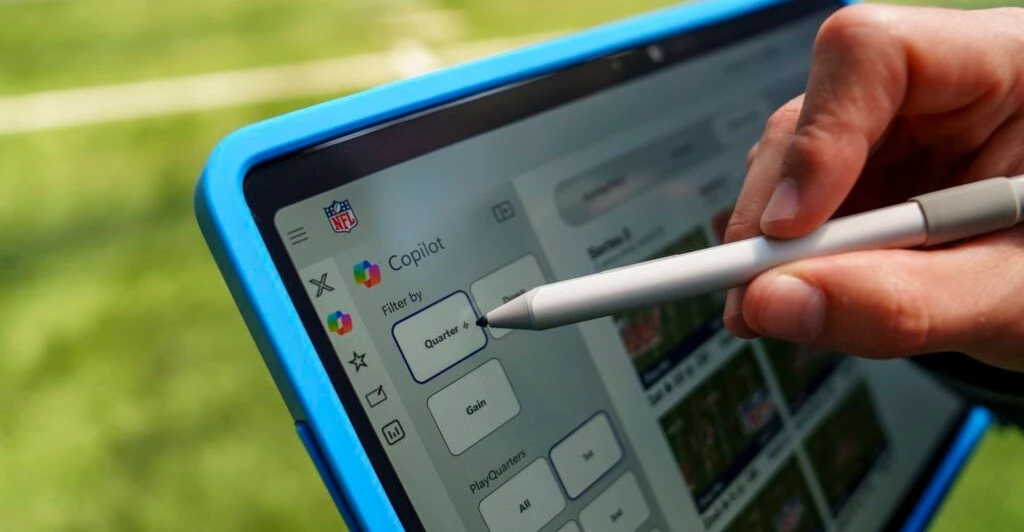
Gone are the days when a Surface tablet was just a sideline prop. Under the latest agreement, over 2,500 Copilot Plus PCs—each powered by Arm-based silicon—will form a distributed, always-on network across every NFL franchise. This is not cloud computing as we know it; it is edge AI, where inference happens locally, milliseconds matter, and the latency of the open internet is an unacceptable risk. The Sideline Viewing System, now effectively a private edge cloud, mirrors the operational demands of sectors like defense and manufacturing, where mission-critical AI must function in the absence of reliable connectivity.
The NFL’s embrace of continuous model retraining—adjusting recommendations on the fly as injuries and formations shift—signals a new era for automated machine learning operations. Models are now expected to ingest, label, and redeploy within the span of a commercial break, foreshadowing a future where MLOps pipelines must be as agile as the athletes they serve.
The Vertical Stack and the Data Dividend
Microsoft’s strategic gambit is not just about selling devices or cloud subscriptions. By embedding both GitHub Copilot (for developer workflows) and Microsoft 365 Copilot (for knowledge workers) into the same operational fabric, the company is showcasing a seamless AI continuum. This vertical integration stands in contrast to the more modular ecosystems of Amazon and Google, and positions the NFL as both a proving ground and a global showroom for Microsoft’s Windows on Arm ambitions.
Beneath the surface, the real asset is data. The league’s proprietary playbooks, historical film, and player tracking information become not just competitive tools, but potential sources of secondary revenue. As AI-generated recommendations become integral to coaching decisions, the need for auditable logs and explainable AI grows acute. The question of “who called the play”—human or algorithm—echoes regulatory debates in finance and healthcare, and hints at a future where data governance and IP rights are as fiercely contested as the games themselves.
Economics, Equity, and the New Rules of Engagement
This partnership is as much about economics as it is about engineering. Where Surface branding once targeted consumers, Copilot branding is now a high-visibility campaign for Microsoft’s enterprise AI portfolio, broadcast to tens of millions each week. For the NFL, the deal offsets the soaring costs of analytics modernization—investments that would otherwise require eight-figure capital outlays.
Yet, the league’s decision to provision AI tools uniformly across franchises is a subtle but profound move. By standardizing access to advanced analytics, the NFL is pre-empting an AI arms race that could otherwise tilt the competitive balance toward wealthier teams. This echoes the league’s longstanding ethos of revenue sharing and competitive parity, and may soon inspire similar “AI salary cap” mechanisms in other industries.
The labor implications are equally striking. Tasks that once consumed 30–40 analyst hours per game—film breakdown, opponent modeling—are now compressed into near-real-time outputs. This labor-efficiency arbitrage frees up headcount for higher-order work, while also hinting at double-digit reductions in administrative roles across functions like finance and HR. The ripple effects, already visible in early Copilot deployments among Fortune 500s, are poised to reshape the very nature of white-collar work.
Risks, Lessons, and the Next Play
No technological leap is without its perils. The NFL’s edge-cloud infrastructure, while robust, remains vulnerable to network disruptions—a risk that business leaders in other sectors would do well to model and budget for. Cultural resistance, especially among veteran coaches, mirrors the skepticism seen in healthcare and other fields where algorithmic recommendations challenge human expertise. And as analytics extend to college prospects, new questions around data privacy and NCAA compliance are sure to test the league’s legal playbook.
For decision-makers beyond the stadium, the implications are clear:
- Pilot AI in bounded, outcome-measurable domains before scaling enterprise-wide.
- Monetize operational “exhaust data” through structured rights management, unlocking new revenue streams.
- Institutionalize explainable operations to avert legal ambiguity and build trust.
- Negotiate data portability and avoid vendor lock-in as single-vendor AI stacks become more attractive.
Ultimately, the NFL’s expanded partnership with Microsoft marks a turning point: AI is no longer an experimental overlay, but an operational core. The lessons from this high-stakes, high-visibility deployment will reverberate far beyond sports, serving as a blueprint for orchestrating edge-to-cloud intelligence, real-time decision support, and technology-driven brand transformation at scale. For those charting the future of enterprise AI, the league has just set a new standard—and the clock is already running.

 By
By
 By
By
 By
By

 By
By
 By
By
 By
By
 By
By







